Off-Grid vs Grid-Tied Solar for Cabins: Which Makes Sense?
Affiliate disclosure: This page contains paid links to Amazon and eBay. If you buy through them, we may earn a commission at no extra cost to you. As an Amazon Associate I earn from qualifying purchases.
If power lines reach your cabin — or could — you face a decision most solar guides skip: go off-grid with batteries, tie into the utility, or split the difference with a hybrid. Each architecture allocates money, resilience, and hassle differently, and the right answer hinges less on ideology than on one number: what a utility connection actually costs at your property.
Here's how the three architectures compare, the line-extension math that decides most remote cases, and the cabin profiles each approach genuinely fits.
The Three Architectures
- Off-grid: panels, charge controller, battery bank, inverter — the cabin is its own utility. No bills, no outages that aren't yours, and total responsibility for every watt-hour, including December's.
- Grid-tied: panels and a grid-tie inverter, no batteries. The grid absorbs your surplus (net metering where offered) and covers your nights and winters. Cheapest hardware per watt — and dead during a grid outage, since grid-tie inverters shut down for line-worker safety.
- Hybrid (grid-tied with battery backup): panels, hybrid inverter, and a battery bank, with the grid as a third partner. Solar self-consumption plus outage resilience plus a utility backstop for winter. The most capable architecture and the most hardware.
The Deciding Number: What the Wire Costs
For cabins without existing service, utility line extension is priced per distance and terrain — and it's routinely staggering: rural extensions commonly run into five figures before the first kilowatt-hour flows. Against that number, a complete off-grid system frequently costs the same or less and the money buys you hardware instead of a wire. This is why the off-grid decision is usually made by geography: close to existing lines, grid or hybrid deserves a real look; a long private road from the nearest pole, off-grid wins before the comparison starts.
Get the utility's written extension quote before designing anything — it's the one number that reorders every other consideration.
Head to Head
| Off-Grid | Grid-Tied | Hybrid | |
|---|---|---|---|
| Hardware cost | $$ (batteries dominate) | $ per watt | $$$ |
| Monthly bill | None | Reduced, plus fixed charges | Small |
| Outage resilience | Total | None — shuts down | High |
| Winter | Your problem: oversize or generator | Grid covers it | Grid covers it |
| Permits/inspection | Often minimal (varies) | Interconnection agreement required | Interconnection required |
| Complexity to operate | Moderate — you're the utility | Zero | Low |
Who Should Choose What
Off-grid fits the remote cabin far from lines, the owner who wants independence as a feature, and any site where the extension quote is absurd — which is most true cabin sites. It demands honest sizing (start with the sizing math) and a winter plan (see the generator hybrid guide).
Grid-tied fits the cabin that already has service and modest goals: shave the bill, keep life simple, accept outage vulnerability. It's the least “cabin solar” of the three — really a small residential install that happens to be rural.
Hybrid fits the served cabin in outage-prone country — storm regions, aging rural feeders — where the battery earns its cost in kept freezers and lit winters, and the grid quietly covers the December problem that pure off-grid spends thousands to solve.
Renogy 200Ah Core LiFePO4
Whichever battery-based architecture you choose, storage is the heart: 200Ah of parallel-expandable LiFePO4 that anchors an off-grid bank or backs up a hybrid. Start with one, grow to the bank your winter demands.
Going Off-Grid: The Complete Route
If the math lands off-grid — and for genuinely remote cabins it almost always does — the cleanest execution is a system engineered as one unit rather than assembled around a maybe-someday grid connection:
Renogy Complete Off-Grid Cabin Solution
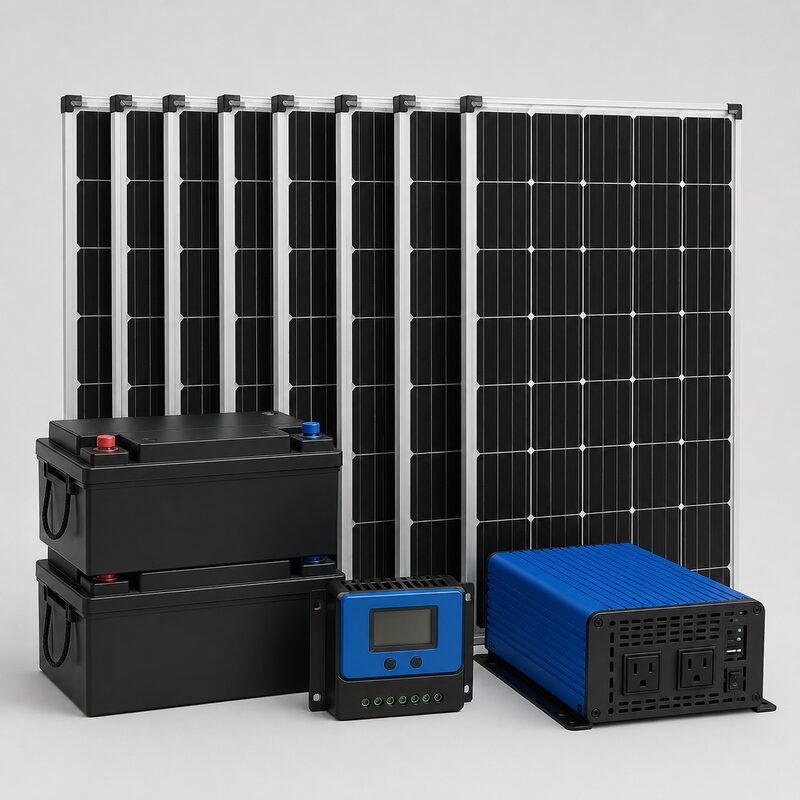
A serious all-in-one package for full-time cabins and workshops — high-efficiency N-type panels, an expandable LiFePO4 battery bank rated at 20.48kWh, and a 3,500W pure sine wave inverter-charger, shipped as one pre-matched kit so nothing gets mismatched.
See Live Price at Renogy →Direct from Renogy — we may earn a commission at no extra cost to you.
Full commissioning details are in the setup guide; the complete kits roundup covers the tiers below whole-cabin scale.
Net Metering Reality: Read Your Utility Before You Believe the Math
Grid-tied economics lean heavily on how your utility credits exported power, and the terms vary enormously — full retail-rate net metering makes the grid a perfect free battery, while avoided-cost or time-varying export rates can credit surplus at a small fraction of what you pay to import it back at night. Rural cooperatives, which serve most cabin country, add their own wrinkles: fixed monthly charges that persist regardless of usage, interconnection fees and inspection requirements, and occasionally caps on system size relative to historical consumption — awkward for a cabin with a thin usage history. Before choosing grid-tied or hybrid, get the actual tariff sheet and interconnection policy, and run the year's math with real export rates. A cabin on generous net metering can rationally go grid-tied with no batteries at all; the same cabin on avoided-cost rates plus a hefty fixed charge often finds the hybrid — or even pure off-grid — math winning despite the wire at the road.
Frequently Asked Questions
Is it cheaper to go off-grid or connect a cabin to the grid?
It depends almost entirely on the utility's line-extension quote. Rural extensions routinely cost as much as a complete off-grid system before any monthly bills, so remote cabins usually favor off-grid, while properties adjacent to existing lines can find connection genuinely cheaper.
Does grid-tied solar work during a power outage?
No — standard grid-tie inverters shut down automatically during outages to protect line workers, so your panels sit idle exactly when you need them. Backup power during outages requires a hybrid system with batteries or a separate generator.
Can I start grid-tied and add batteries later?
Yes, if you choose a hybrid-ready inverter up front — retrofitting batteries onto a plain grid-tie inverter usually means replacing it. Cabins planning eventual backup should buy the hybrid inverter first and add storage when the budget allows.
Do off-grid cabins need permits?
Rules vary widely: many rural counties are hands-off about off-grid systems on private cabins, while others require electrical permits for permanent structures at any scale. Grid-tied and hybrid systems always involve a utility interconnection agreement. One call to the county saves guessing.
What happens to extra solar power in each system?
Off-grid, surplus beyond a full battery is simply not harvested — arrays are sized accepting that. Grid-tied, surplus exports to the utility for net-metering credit where offered. Hybrid systems fill the battery first, then export, which is the most productive use of every panel.