
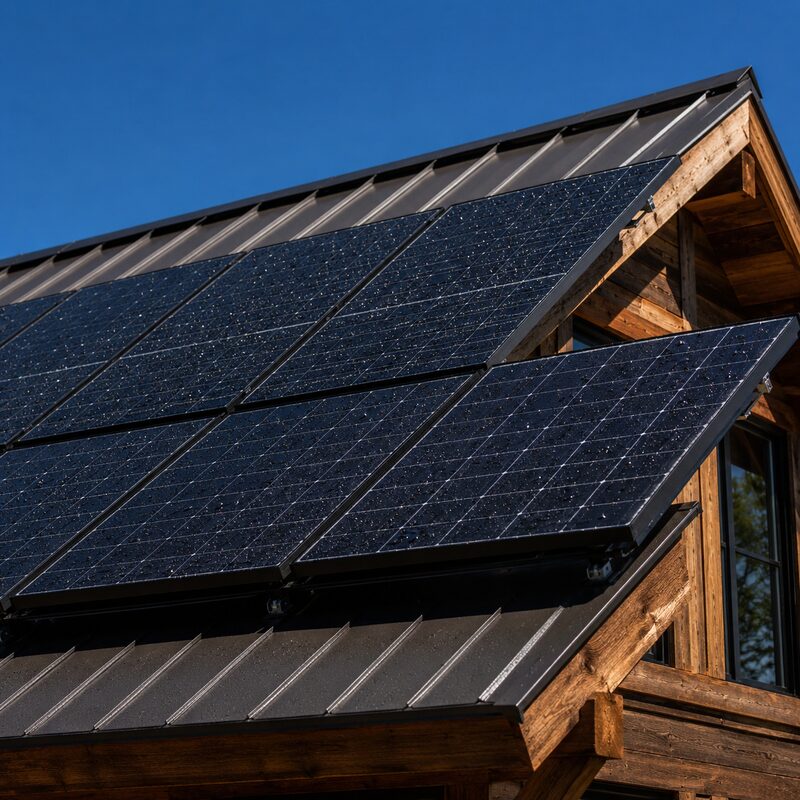
Best Solar Panels for Cabins (2026)

Rigid monocrystalline panels ranked for off-grid cabins — the most efficient, durable way to capture power from a fixed roof.

Your panels are the engine of the whole system, so this is where quality pays off for 25+ years. For a fixed cabin roof you want rigid monocrystalline panels — they're more efficient, far more durable, and handle heat and low light better than the alternatives. We've ranked the best 100W and 200W panels for off-grid cabins below.

Our top pick: the Renogy 100W Monocrystalline panel — efficient, rugged, endlessly expandable, and supported by the largest off-grid ecosystem around.

PanelPowerCell TypeEfficiencyBest ForPrice
Renogy 100W Mono100WMono~22%Most builds$
BougeRV 200W N-Type200WN-typeHighPremium / tight roofs$$
Rich Solar 200W Mono200WMono~21%Fewer connections$$
Newpowa 100W Mono100WMono~20%Budget$
WEIZE 100W Mono100WMono~21%Beginners$
HQST 100W Mono100WMono~21%Value arrays$
Reviews · 2026

The Best Cabin Solar Panels, Ranked

Best Overall
100W · Monocrystalline

Renogy 100W Monocrystalline Panel

The default 100W panel for off-grid builds, and for good reason: efficient mono cells, a rugged aluminum frame, and bypass diodes for better shade performance, backed by Renogy's broad ecosystem and support.

Power
100W
Efficiency
~22%
Cells
Mono
Warranty
25 yr
  • High module efficiency for its size
  • Corrosion-resistant aluminum frame
  • Bypass diodes minimize shade losses
  • Standardized size for easy expansion
Best Premium
200W · N-Type 9BB

BougeRV 200W N-Type Panel

N-type cells hold output better in heat and over the years than standard P-type, and nine busbars improve low-light and partial-shade performance. A premium choice for cabins that need every watt from limited roof space.

Power
200W
Cells
N-type
Busbars
9BB
Degrade
Low
  • N-type cells resist heat and age better
  • 9 busbars boost shade and low-light output
  • More watts per square foot of roof
  • Strong choice for tight mounting areas
Best 200W
200W · Monocrystalline

Rich Solar 200W Mono Panel

A single 200W panel does the work of two 100W panels with half the wiring and connections — simpler installs and fewer failure points. Rich Solar's build quality and warranty make this a reliable backbone panel.

Power
200W
Efficiency
~21%
Cells
Mono
Warranty
25 yr
  • One panel replaces two 100W units
  • Fewer connections to wire and seal
  • Durable frame rated for high wind/snow
  • Good value per watt
Best Budget
100W · Monocrystalline

Newpowa 100W Mono Panel

When you need watts on a budget — for a shed, a backup bank, or to expand an existing array — Newpowa's 100W mono panel delivers dependable output at one of the lowest costs per watt available.

Power
100W
Efficiency
~20%
Cells
Mono
Cost
Low
  • Among the lowest cost per watt
  • Solid mono output for the price
  • Great for expanding an existing array
  • Compact, standard 100W footprint
Best for Beginners
100W · Mono

WEIZE 100W Mono Panel

A popular, well-reviewed 100W panel that balances price and quality. A safe, no-drama pick for first-time builders who want reliable output without overthinking the spec sheet.

Power
100W
Efficiency
~21%
Cells
Mono
Frame
Aluminum
  • Reliable, widely used 100W panel
  • Pre-drilled holes for fast mounting
  • Tempered glass and aluminum frame
  • Easy to source and expand
Best Value 100W
100W · Mono

HQST 100W Mono Panel

HQST shares manufacturing lineage with bigger names and undercuts them on price. Strong low-light performance and a rugged frame make it a smart value pick for cabin arrays of any size.

Power
100W
Efficiency
~21%
Cells
Mono
Cost
Low
  • Excellent price-to-performance
  • Good low-light and cloudy-day output
  • Heavy-duty frame and tempered glass
  • Compatible with standard mounts
Questions

Cabin Solar Panel FAQs

Monocrystalline or polycrystalline for a cabin?
Monocrystalline, almost always. Mono panels are more efficient and perform better in low light and tight spaces — which matters on a cabin roof. Poly panels are slightly cheaper but rarely worth the efficiency hit today.
How many solar panels does a cabin need?
Work backward from your daily energy use. As a rough guide: a weekend cabin needs 2–4 panels (200–400W), while a full-time cabin often needs 6–8+ (600–800W). Our sizing guide shows the full calculation.
Rigid or flexible panels for a cabin roof?
Rigid panels are the right choice for a fixed cabin roof — they're more efficient, last far longer (25+ years vs ~5), and dissipate heat better. Flexible panels are mainly for curved surfaces and weight-sensitive installs like vans and boats.
Will panels work on a north-facing or shaded roof?
They'll work but produce less. South-facing with minimal shade is ideal in the northern hemisphere. If shade is unavoidable, panels with more busbars (9BB) and a quality MPPT controller help recover output. You may also simply add more panels to compensate.

Affiliate Disclosure: SolarCabin.co is reader-supported. When you buy through links on our site, we may earn an affiliate commission at no additional cost to you. As an Amazon Associate and eBay Partner, we earn from qualifying purchases. We only recommend products we genuinely believe in, and we never invent specs or reviews.