 Solar
Solar
Cabin Solar Sizing Guide: How Much Do You Need?
A plain-English walkthrough to size your panels, battery bank, and inverter — no engineering degree required.
Sizing an off-grid system comes down to one question: how much energy do you use in a day? Once you know that, everything else — panels, battery, controller, inverter — follows. Here's the whole process in four steps.
Step 1 — Add up your daily energy use
List every device, multiply its wattage by the hours you run it, and total the watt-hours (Wh). For example:
- LED lights: 40W × 5h = 200 Wh
- 12V fridge: ~50W averaged × 24h = 1,200 Wh
- Laptop + phones: 60W × 4h = 240 Wh
- Water pump, fan, TV, etc.: ~400 Wh
That sample cabin uses roughly 2,000 Wh (2 kWh) per day. Tally your own devices the same way.
Step 2 — Size your solar array
Divide your daily Wh by your peak sun hours (typically 3–6, use a low number for winter), then add ~20% for losses and aging:
Array watts = (Daily Wh ÷ Sun hours) × 1.2
For 2,000 Wh at 5 sun hours: (2000 ÷ 5) × 1.2 = ~480W, so a 400–600W array fits. In a low-sun region, lean toward the higher end.
Step 3 — Size your battery bank
Store 1–2 days of use so you can ride out cloudy weather. For LiFePO4 (which you can safely discharge deeply), divide daily Wh by your battery voltage:
Battery Ah = (Daily Wh × Days reserve) ÷ Battery voltage
For 2,000 Wh, 1 day reserve, 12V: 2000 ÷ 12 = ~167Ah, so a 200Ah LiFePO4 bank gives a comfortable day of backup.
Step 4 — Size your controller and inverter
Charge controller: divide array watts by battery voltage, add 25% headroom. A 480W array at 12V ≈ 40A, so a 40A MPPT controller fits. Inverter: add up the watts of everything that might run at once, plus surge headroom for motors — most cabins land at 2000–3000W.
Recommended System by Cabin Type
A starting point — always check against your own daily-use total.
| Cabin Type | Daily Use | Array | Battery (12V) | Inverter | Suggested Kit |
|---|---|---|---|---|---|
| Shed / hunting cabin | ~0.5 kWh | 100–200W | 100Ah | 1000–2000W | 100–200W kit |
| Weekend cabin | ~1 kWh | 200–300W | 100–200Ah | 2000W | 300W kit |
| Seasonal cabin | ~2 kWh | 400–600W | 200Ah | 2000–3000W | 400–600W kit |
| Full-time cabin | ~3–5 kWh | 600–800W+ | 300Ah+ | 3000W | 800W kit |
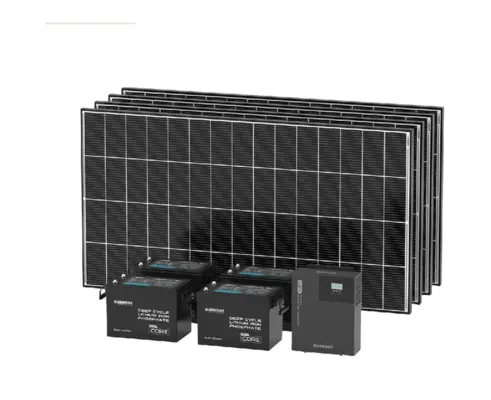
Not sure? Round up. Solar panels and lithium batteries are easy to add later, and a little extra capacity means fewer dark evenings and less generator time. Start with a complete cabin solar kit sized to the table above.
Start With a Complete Kit
Skip the guesswork — our ranked cabin solar kits ship pre-matched and ready to install.
See the Best Cabin Solar Kits