Best All-in-One Hybrid Inverters for Cabin Solar 2026
Affiliate disclosure: This page contains paid links to Amazon and eBay. If you buy through them, we may earn a commission at no extra cost to you. As an Amazon Associate I earn from qualifying purchases.
An all-in-one hybrid inverter combines the MPPT charge controller, inverter, and transfer switch into a single wall-mount box. For a modern off-grid cabin build, they've mostly displaced the old three-box approach — and picking the right one for your loads, voltage, and future expansion is one of the highest-leverage decisions in the entire system.
What "All-in-One" and "Hybrid" Actually Mean
Two overlapping words that get used interchangeably in solar marketing. Let's separate them:
All-in-one inverter
A single box that contains: DC-to-AC inverter, MPPT charge controller (usually two or more MPPT inputs), AC transfer switch, and typically a communication port for battery BMS. You wire panels in, batteries in, AC loads out, and (optionally) a generator or grid input.
Compared to buying an inverter, charge controller, and transfer switch separately, an all-in-one gives you:
- Roughly 40–60% fewer parts to buy and wire
- Coherent monitoring in one app instead of three
- Single warranty and single support call
- Lower total footprint and cleaner install
Hybrid inverter
An inverter that can pull power from both DC (batteries + solar) and AC (grid or generator) simultaneously, and can prioritize source based on rules you set. Every modern all-in-one inverter is a hybrid; a pure off-grid inverter that only pulls from DC is technically not hybrid.
For off-grid cabins, "hybrid" matters because it lets you plug a backup generator into the inverter's AC input and have the inverter automatically:
- Detect when the battery drops below your threshold
- Signal the generator to start
- Charge the battery from the generator
- Signal the generator to stop when charged
That auto-start/auto-charge behavior is the difference between a system you have to babysit and a system you can leave alone for a week.
Sizing an All-in-One Hybrid for a Cabin
Three specs matter when sizing a hybrid inverter for a cabin. All-in-ones bundle them differently, so read the datasheet, not just the marketing.
1. Continuous AC output (watts)
The steady-state power the inverter can deliver at 120V AC (or 120/240V for split-phase units). Size this for your realistic peak concurrent load, not average daily load.
- Weekend cabin, lights and small fridge: 2,000–3,000W is plenty
- Standard family cabin with well pump, microwave, coffee maker: 3,000–5,000W
- Full-time cabin with mini-split, well pump, workshop tools: 6,000–8,000W
- All-electric cabin with induction cooktop, heat pump water heater: 12,000–15,000W split-phase
2. Surge capacity (watts)
The peak power the inverter can deliver briefly (usually 5–20 seconds) for motor startup. Well pumps, refrigerator compressors, and mini-splits can spike to 3–5x their running wattage on startup.
A well pump rated for 750W running might spike to 2,500W for the first second. If your inverter's surge rating is 4,000W, you have plenty of margin. If it's 2,200W, the pump might not start when the fridge is also running.
3. Solar input (watts and voltage)
The maximum solar array you can wire to the inverter's built-in MPPTs. Two things to check:
- Max PV watts per MPPT and total (e.g. "6,000W total across two MPPTs, 3,000W max per MPPT")
- Max PV voltage (the open-circuit voltage of your panel string on a cold morning) — commonly 500V or 600V DC
Under-panel a hybrid and you leave capacity on the table. Over-panel by up to 30% is generally fine and preferred (you clip a bit at peak noon in summer but harvest more energy on cloudy days and winter mornings).
Battery voltage compatibility
Match your battery bank voltage to the inverter's supported range. Most modern hybrids in this class are 48V nominal (43–60V operating range). A few 24V units still exist for smaller systems. 12V hybrid inverters top out around 3,000W for physics reasons — the DC current draw at 12V gets unmanageable above that.
Split-Phase vs. Single-Phase: Do You Need 240V?
North American residential appliances split into two camps:
- 120V single-phase: everything you plug into a standard wall outlet. Fridges, microwaves, TVs, LED lights, laptops, small kitchen appliances.
- 120/240V split-phase: bigger appliances hardwired to a 240V breaker. Well pumps (many but not all), electric water heaters, electric dryers, electric ovens, central AC, EV chargers, welders.
If your cabin has zero 240V loads, a single-phase hybrid inverter is fine and cheaper. If your cabin has even one 240V load — a deep well pump is the most common — you need either:
- A split-phase hybrid inverter that outputs 120/240V natively (Sol-Ark 8K/12K/15K, EG4 6000XP with second unit, Schneider XW Pro, Victron Quattro with autotransformer)
- Two single-phase inverters stacked in a master/slave configuration (some EG4, Growatt, and MPP Solar units support this)
- A single-phase inverter + step-up autotransformer to derive 240V from 120V (works, but adds complexity and loss)
For a fresh full-time cabin build, split-phase is worth the modest cost premium. Well pumps, mini-splits with electric backup heat, and hypothetical future upgrades (EV, workshop) all benefit.
Best All-in-One Hybrid Inverters by Cabin Size
Growatt SPF 5000ES
Growatt's SPF 5000ES has become the small-cabin default for good reason: 5kW continuous at a price point that undercuts nearly every competitor, dual MPPT inputs, integrated 80A charger, and a real US distributor channel through Signature Solar and others. Bring your own 48V battery bank. Best when you want a competent 48V hybrid for a standard cabin without paying premium prices.
EG4 6000XP All-in-One
The EG4 6000XP was a genuine market shakeup when it launched — split-phase 120/240V output from a single unit at a price point that used to only get you single-phase. Native closed-loop CAN communication with EG4 LL-S rack batteries makes charge/discharge management painless. Signature Solar handles US support. Best when you want split-phase for a well pump or 240V loads without stacking two units or spending Sol-Ark money.
Sol-Ark 12K / 15K
Sol-Ark is the workhorse hybrid inverter for serious cabin and homestead installations. Widely respected engineering, best-in-class generator integration (auto-start with two-wire signal and programmable start/stop rules), wide temperature tolerance for unheated equipment sheds, and a 10-year warranty. Costs more than the competition and worth it for full-time cabins where reliability matters more than price per watt. Best when you want the hybrid inverter you don't have to think about for a decade.
Bluetti EP760 Home Backup System
Bluetti's EP760 packages the inverter, battery, MPPT charge controllers, and monitoring into a single stackable ecosystem. If you value coherent design, best-in-class app control, and don't want to source batteries separately, the EP760 is polished in a way that most component-based competitors aren't. Best when you want an all-in-one where the battery is part of the "all."
Shop Bluetti EP760 → →Victron MultiPlus-II 48/5000 + SmartSolar MPPTs
Victron's approach is modular: the MultiPlus-II handles inverter/charger/transfer switching, separate SmartSolar MPPT charge controllers handle solar, and the Cerbo GX controller monitors everything. Costs more upfront and requires more setup expertise, but the flexibility, remote monitoring, and long-term repairability are unmatched. Best when you want an inverter ecosystem you can genuinely maintain and expand for 15+ years.
Features That Actually Matter (and Ones That Don't)
Features that matter for a cabin
- Generator auto-start: Two-wire signal to a generator with a start solenoid, programmable low-battery-voltage or low-SOC start threshold, and programmable stop condition (fully charged or generator run time). Non-negotiable for a full-time cabin.
- Closed-loop BMS communication: CAN or RS485 talk between inverter and battery BMS. Lets the battery tell the inverter its real state of charge, temperature, and cell balance instead of the inverter guessing from voltage alone. Meaningfully improves charge management.
- Wide DC input voltage range: 300–500V or 500–600V MPPT range gives you flexibility on panel stringing. A narrow range forces you to design your PV array around the inverter.
- Cold-weather operation: Rated for -25°C or colder if you're in a cold climate. Some cheaper units start derating (or refusing to work) below freezing.
- Genuinely working remote monitoring: Sol-Ark's cloud, Victron VRM, and EG4's monitoring all work in the real world. Some competitors promise it and deliver a broken app.
Features often oversold
- Grid-tie functionality (for pure off-grid cabins): Every modern hybrid can grid-tie. If your cabin will never see the grid, this feature is irrelevant.
- Peak surge specs measured for milliseconds: Compare 5-second surge ratings, not "surge" numbers with no duration. Motor startup takes multiple seconds.
- Ultra-high efficiency ratings: The difference between 94% and 96% inverter efficiency is real but modest. Buy for the features you need first.
Install Notes for Cabin Hybrid Inverters
Wall-mount hybrid inverters are heavy (60–120 lb typical) and need mounting into structure. A few practical considerations:
- Ventilation: Every hybrid inverter has an operating temperature range. Give it 12–18 inches of clearance above and to the sides. Do not enclose in a sealed cabinet.
- Location: Ideally in an interior conditioned space (mechanical room, closet, mudroom). If it has to live in an unheated outbuilding, buy a model rated for cold weather.
- DC disconnect between battery and inverter: Required by code, and you'll want it for service anyway.
- AC input transfer: When you connect a generator to the AC input, the inverter's internal transfer switch handles source switching. Make sure the generator's neutral bonding matches what the inverter expects — misconfigured neutrals cause weird ground-fault behavior.
- Grounding: Off-grid systems still need a proper equipment grounding electrode conductor per NEC 250. This is not optional.
For a fresh install, budget a full day for DIY wiring of a 6–8kW hybrid inverter with batteries and PV. For a first-time DIYer, budget two days and expect to make a couple of trips to the hardware store.
Deeper coverage of the whole system architecture is in our off-grid cabin solar buyer's guide, and our battery bank guide covers the battery side in detail.
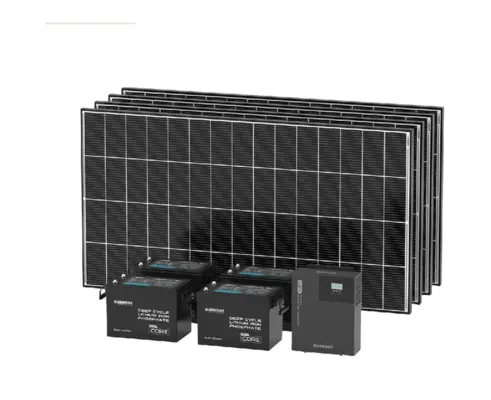 Renogy Cabin Solution — Complete Off-Grid Solar Kit →
Frequently Asked Questions
What is an all-in-one hybrid inverter?
A single box that combines the DC-to-AC inverter, MPPT solar charge controller, AC transfer switch, and battery management interface. You wire panels, batteries, and AC loads to one unit instead of stringing together three or four separate components. Every modern all-in-one is also a hybrid, meaning it can accept AC input from a grid or generator in addition to solar and battery.
Do I need a split-phase 240V hybrid inverter for a cabin?
Only if you have 240V loads. Deep well pumps, electric water heaters, electric dryers, central AC, and EV chargers are typically 240V. If your cabin runs entirely on 120V loads (lights, standard outlets, small appliances, propane cooking/heating), a single-phase 120V-only inverter is fine and cheaper. For any full-time cabin build, split-phase is worth the modest premium.
What size hybrid inverter do I need for a cabin?
Size for peak concurrent load, not daily average. Small weekend cabin: 2,000–3,000W. Standard family cabin with well pump and appliances: 4,000–6,000W. Full-time cabin with mini-split and workshop: 6,000–8,000W. All-electric cabin with induction cooking: 12,000–15,000W split-phase.
Is Sol-Ark worth the extra money vs. EG4 or Growatt?
For a full-time cabin where reliability matters more than price, yes. Sol-Ark has best-in-class generator integration, a 10-year warranty, mature firmware, and wide industry respect. For a weekend cabin or someone chasing the best cost-per-kW, EG4 6000XP and Growatt SPF are genuinely serviceable at meaningfully lower prices.
Can a hybrid inverter auto-start a backup generator?
Yes, if both the inverter and the generator support two-wire auto-start. The inverter monitors battery state of charge or voltage and signals the generator to start when the battery drops below a threshold you set. When the battery is charged, it signals the generator to stop. Sol-Ark, Schneider, and Victron implement this reliably; some cheaper inverters implement it in a basic form that works most of the time.
What's the difference between hybrid and off-grid inverters?
An off-grid inverter only pulls power from DC (battery + solar). A hybrid inverter can also pull from AC (grid or generator) and can prioritize between sources based on programmable rules. For a modern off-grid cabin build, hybrid is the practical choice because it lets you integrate a backup generator cleanly.
Can I stack two hybrid inverters for more power?
Some models yes, others no. Sol-Ark, Victron MultiPlus-II, some Growatt units, and some EG4 units support parallel or master/slave stacking to double or triple continuous output. Bluetti and EcoFlow all-in-ones generally do not. If future expansion matters, check the datasheet's stacking capability before buying.
Do I still need a separate charge controller with an all-in-one hybrid?
No. All-in-one hybrid inverters include integrated MPPT charge controllers (usually two or more MPPT inputs). You wire panels directly to the inverter's PV input terminals. Adding a separate external MPPT is only useful if you're expanding solar beyond the inverter's built-in MPPT capacity.