Best Solar Kits for Small Cabins (2026)
Affiliate disclosure: This page contains paid links to Amazon and eBay. If you buy through them, we may earn a commission at no extra cost to you. As an Amazon Associate I earn from qualifying purchases.
A small cabin is the perfect solar candidate: modest loads, a simple roof, and no utility bill to compare against — just the question of which kit covers your lights, fridge, and devices without drama. The problem is that “small cabin solar kit” listings range from a single panel to systems that would run a suburban house, and the marketing rarely tells you which one your cabin actually needs.
Below are the kits we'd genuinely put on a small cabin in 2026, organized by what you're running — plus the thirty seconds of sizing math that keeps you from buying the wrong one. If your cabin is larger or full-time, jump to our complete off-grid kits guide instead.
Quick Sizing: What Does “Small” Actually Run?
Small-cabin loads cluster into three profiles. Find yours and the kit size follows:
| Profile | Running | Daily Use | Kit Size |
|---|---|---|---|
| Bare bones | LED lights, phone/tool charging | 300–600Wh | 100–200W |
| Weekender | + 12V fridge, fan, laptop | 1,000–1,800Wh | 300–400W |
| Comfortable | + water pump, TV, more hours | 2,000–3,000Wh | 600W+ |
Remember most panel-plus-controller kits don't include a battery or inverter — budget roughly 2kWh of lithium storage per 1,500Wh of daily use, and a pure sine inverter sized to your biggest simultaneous load.
Our Top Picks
Renogy 400W Premium Kit
The default answer for a weekend small cabin. Four 100W monocrystalline panels, a 40A MPPT controller that actually harvests efficiently in cold and cloud, and Bluetooth monitoring so you can watch production from the porch. Add a 200Ah lithium battery and a 2,000W inverter and this is a complete, comfortable small-cabin system.
ECO-WORTHY 200W Kit
The cheapest sane path onto solar. Two 100W panels, a 30A controller, and mounting hardware cover lights, charging, and a small 12V fridge at a basic cabin. The controller and wiring are basic but honest — and the kit expands later if your needs grow.
Renogy 100W Starter Kit
One panel, one controller, zero complexity. Keeps a battery topped for lights and device charging at a shack or shed, and the 30A controller quietly supports up to 400W of panels when you inevitably add more.
BougeRV 300W 9BB Kit
Small cabins usually mean trees, and trees mean moving shade. BougeRV's nine-busbar cells hold output through partial shading and low light dramatically better than standard panels — the difference between a fridge that stays cold and one that doesn't on a filtered-light site.
Rich Solar 600W Kit
For the small cabin that lives large: six panels and a 60A MPPT controller run a full-size fridge, water pump, lights, and electronics with real margin. If you're between sizes and use the cabin more than one weekend a month, buy this one.
The One-Box Alternative
If you'd rather skip assembling storage and an inverter around a panel kit, Renogy's bundled approach ships the matched pieces together — panels, MPPT charging, and monitoring in one compatible package that a battery of your choice drops straight into:
Renogy 800W 12V Versatile Kit
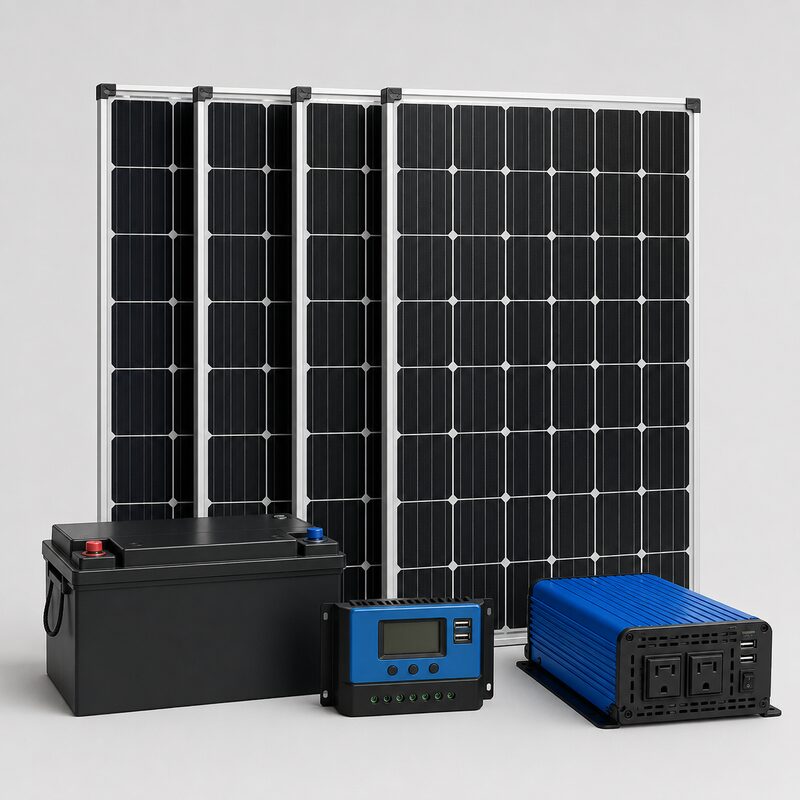
Renogy’s workhorse starter bundle — monocrystalline panels, an MPPT charge controller, and Bluetooth monitoring in one compatible package. The easiest way to get a weekend or part-time cabin onto solar without piecing components together yourself.
See Live Price at Renogy →Direct from Renogy — we may earn a commission at no extra cost to you.
How We Chose
Every pick above had to clear four bars: real-world reviews from off-grid users (not RV weekenders on shore power half the time), honest component quality — actual mono panels with output warranties, controllers that meet their ratings — expandability, because small cabins never stay small, and support, meaning a manufacturer that answers warranty email in year three. We skip kits with modified sine inverters, missing fuses, or headline wattages that describe the inverter instead of the panels.
Small-Cabin Kit Mistakes to Skip
- Buying panels without pricing storage. The battery typically costs as much as the panel kit. Budget both from the start.
- PWM controllers past 200W. The 20–30% harvest penalty is real, and worst in exactly the marginal-light conditions small cabins face.
- Ignoring winter. A 400W array that coasts in July can starve in January. If you visit year-round, size up or plan a small generator.
- Roof-mounting on a shaded roof. A ground mount ten steps south of the cabin often out-produces the roof on wooded lots — and you can sweep snow off it.
Next steps: run your loads through the panel-count guide, pick storage from the battery bank guide, and wire it all up with the wiring guide.
What a Small-Cabin System Costs to Complete
Since most kits here include panels and a controller only, plan the full bill of materials before comparing anything: the battery (typically the largest single line item — a 100–200Ah LiFePO4 for most small cabins), a pure sine inverter sized to your biggest simultaneous load, a battery fuse and disconnect, a small DC fuse block for lights and pump circuits, and mounting sealant plus stainless hardware if your roof needs it. As a planning ratio, the panel kit usually represents only a third to half of the complete system spend. That's not a criticism of kits — it's just the honest shape of solar budgets, and knowing it up front prevents the classic stall where panels sit in a shed all summer waiting for a battery budget.
The corollary: when comparing a panels-only kit against a kit that includes lithium storage, add realistic storage cost to the first before judging. The bundled kit frequently wins the completed-system comparison it appeared to lose on sticker.
Installation Reality Check for Small Cabins
A 200–400W small-cabin install is a genuine one-weekend project for a careful owner: mounting brackets and sealing on day one, wiring and commissioning on day two. The tasks that consume unexpected time are never the ones people worry about — panel mounting is straightforward — but the small-parts logistics: crimping proper lugs onto battery cable, locating rafters under old roofing, and the trip to town for the wire size the plan underestimated. Order cable, lugs, fuses, and sealant with the kit, one gauge and one size up where in doubt, and the weekend estimate holds. The roof mounting guide and wiring guide cover both days in detail.
Small Cabin, Big Trees: The Shade Playbook
Most small cabins live under canopy, and shade management determines real-world output more than panel brand does. The playbook, in order of impact: put the array where the sun is, even if that's a ground mount in the garden rather than the picturesque roof — a 30-foot cable run costs a fraction of the production lost to a shaded roof. Wire panels in parallel or short series-parallel strings so one shadow doesn't collapse the whole array's output. Choose multi-busbar panels (like the BougeRV pick above) that degrade gracefully under partial shade instead of cliff-diving. And audit seasonally: the oak that cleared the array in June shades it in October when the sun drops, so walk the site at midday in the worst month you'll occupy. An hour with a pruning saw is routinely worth more than an extra panel.
Frequently Asked Questions
What size solar kit does a small cabin need?
Most small cabins land between 200W and 400W of panels with 2–3kWh of lithium storage. A bare-bones shack running lights and charging can get by on 100–200W; add a fridge and regular weekend use and 400W is the comfortable answer.
Will a 400W kit run a refrigerator?
A 12V compressor fridge, yes, comfortably — those average around 40–50W. A full-size household fridge draws more and cycles harder; for that, step up to 600W+ of panels and at least 4kWh of storage so cloudy days don't spoil the groceries.
Do these kits include batteries and inverters?
The panel kits listed here include panels, a charge controller, cabling, and mounts — storage and inverter are separate purchases. That's normal for the category and lets you choose battery capacity independently. Complete systems with storage included are covered in our off-grid kits guide.
Can I start small and expand later?
Yes — it's the classic path. Buy a kit whose controller has amp headroom (a 30–40A controller on a 100–200W start), keep panel models consistent when adding, and choose lithium storage that supports parallel expansion.
Roof mount or ground mount for a small cabin?
Roof mounts win on simplicity and theft-resistance when the roof faces south and clears the tree line. Ground mounts win on wooded sites, for snow clearing, and for seasonal tilt adjustment. Small arrays make ground mounts cheap enough that sun exposure should make the call.