Best MPPT Charge Controllers for Cabin Solar (30A–60A)
Affiliate disclosure: This page contains paid links to Amazon and eBay. If you buy through them, we may earn a commission at no extra cost to you. As an Amazon Associate I earn from qualifying purchases.
The charge controller is the least glamorous and most consequential component in a cabin solar system. It decides how much of your array's output actually reaches the battery, whether your expensive lithium bank charges on the correct profile, and how much room you have to expand. A good MPPT controller routinely harvests 20–30% more energy than a PWM unit on the same panels — the cheapest “extra panel” you'll ever buy.
Below: the MPPT controllers we trust at 30A, 40A, and 60A — the three sizes that cover essentially every cabin — plus the two-minute sizing method that tells you which amperage you need.
Controller Sizing in Two Minutes
An MPPT controller's amp rating is its output limit into the battery. Size it with this formula: array watts ÷ battery voltage × 1.25 safety margin.
| Battery Voltage | 30A Handles | 40A Handles | 60A Handles |
|---|---|---|---|
| 12V bank | ~300W array | ~400W array | ~600W array |
| 24V bank | ~600W | ~800W | ~1,200W |
| 48V bank | ~1,200W | ~1,600W | ~2,400W |
Also check the controller's maximum PV input voltage against your string's open-circuit voltage — and remember cold weather pushes panel voltage up 10–20%. A string that's fine in July can exceed the ceiling on a subzero January morning, which is exactly when you can't afford a dead controller.
Best MPPT Controllers for Cabins
Renogy Rover 40A MPPT
The cabin-world default for good reason: reliable tracking, correct lithium/AGM/gel profiles, clear fault protection, and optional Bluetooth monitoring through Renogy's app. On a 12V bank it carries a 400W array; on 24V, a full 800W — covering the entire weekend-to-part-time cabin range with one unit.
Victron SmartSolar 100/30
The controller electricians recommend to each other. Victron's tracking algorithm is measurably excellent in cloud and partial shade, the built-in Bluetooth and VictronConnect app are the best monitoring experience in the category, and the five-year warranty is backed by a company that supports decade-old products.
EPEver Tracer 30A MPPT
A proven budget MPPT that meets its ratings — genuine tracking, programmable charge profiles, and a wide install base with years of field reports. The interface is dated and the app is clunky, but the harvest is real, and for a 300W-and-under cabin array it's the value pick.
Renogy Rover 60A MPPT
The step-up for full-time cabins: 60A of output supports 600W on 12V or 1,200W on 24V, with the same profile options and monitoring ecosystem as its smaller sibling. If your five-year plan includes a bigger array, this is the controller that won't need replacing to get there.
Victron SmartSolar 150/60
For serious full-time systems: a 150V input window swallows long high-voltage strings from a distant ground mount, the 60A output charges 24V and 48V banks at real speed, and it integrates natively with Victron shunts and monitors if you're building out a whole-system dashboard.
MPPT Features Worth Paying For
- A real lithium profile with adjustable absorption voltage — not just an “LI” sticker. Your battery's datasheet lists the target voltages; the controller must be able to hit them.
- Temperature compensation (with a battery sensor) for AGM banks, and low-temperature charge cutoff for lithium in unheated cabins — charging frozen LiFePO4 causes permanent damage.
- Monitoring you'll actually check. Bluetooth apps turn the controller into a system health dashboard; production history is how you catch a failing connection or creeping shade problem early.
- High PV input voltage (100V+) if your array sits away from the cabin — series strings at higher voltage make long runs cheap.
- A load output terminal on smaller controllers: handy low-voltage disconnect protection for DC lights and pumps without extra hardware.
MPPT vs PWM: The Short Version
PWM controllers connect panels more-or-less directly to the battery, throwing away the voltage difference. MPPT controllers convert that excess voltage into charging current, which is where the 20–30% harvest gap comes from — widening in cold weather and marginal light, exactly cabin conditions. PWM still makes sense for sub-200W trickle systems where controller cost dominates. Everything larger: MPPT. The full breakdown lives in our MPPT vs PWM explainer.
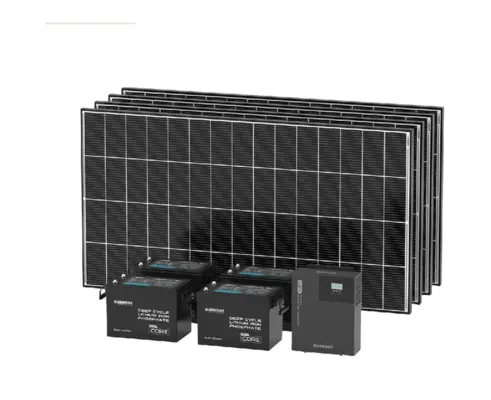 Renogy Cabin Solution — Complete Off-Grid Solar Kit →
Wiring the controller in: keep it within a few feet of the battery bank, size cables per the manual, fuse both the PV input and battery side, and connect battery before panels — commissioning order details are in the setup guide.
Renogy Cabin Solution — Complete Off-Grid Solar Kit →
Setting Up Your MPPT Correctly: The Fifteen-Minute Job That Determines Everything
An MPPT controller charging on the wrong profile quietly undercharges or overcharges the most expensive component in your system, so commissioning settings deserve real attention. The sequence: connect battery before panels (always), then set the battery chemistry — and for lithium, don't stop at the preset. Open your battery's datasheet and verify the controller's absorption/boost voltage matches the manufacturer's specified charge voltage, float is at or below their recommendation (some lithium vendors prefer float disabled or very low), and low-temperature charge cutoff is enabled if the bank lives anywhere that might freeze. For AGM banks, attach the temperature sensor to the battery case — temperature-compensated charging is the difference between a four-year and a six-year AGM life. Finally, note every setting in your system documentation; controllers occasionally reset to defaults after firmware updates or deep discharges, and knowing your correct numbers turns that from a mystery into a two-minute fix.
One Controller or Two? Splitting the Array
Past a certain scale — or on complicated sites — two smaller controllers beat one large one. The cases: mixed orientations, where east-roof and west-roof panels fight each other on a single tracker but each harvest fully on their own controller; mixed panel models after an expansion, where a second controller lets old and new arrays each run at their own power point; long ground-mount runs, where a dedicated high-voltage-input controller for the distant array keeps cable costs sane; and redundancy, which off-grid living teaches you to price properly — with two controllers, a failure means half production while the replacement ships, not a dark cabin. The cost penalty for splitting is small at cabin scale, and both units report into the same battery bank without any coordination hardware. If your site has two distinct sun exposures, design for two controllers from the start.
Controller Lifespan and the Signs of a Failing Unit
Quality MPPT controllers run 10–15 years; heat is what shortens them. Mount the unit vertically on the power wall with the clearances the manual specifies, out of sun and away from the inverter's exhaust, and it will bore you for a decade. The failure signs worth knowing: charging current that declines over weeks with no shading explanation, a unit that runs noticeably hotter than it used to at the same output, relay clicking or restart loops around solar noon, and display or Bluetooth dropouts. Any of these during warranty is a replacement claim — another argument for registering the purchase and keeping settings documented. Out of warranty, replacement almost always beats repair, and it's the natural moment to buy the next size up for whatever the array has grown into.
Frequently Asked Questions
What's the best 30 amp MPPT charge controller?
For most cabins, the Victron SmartSolar 100/30 if the budget allows — best-in-class tracking and monitoring — or the EPEver Tracer 30A as the proven value pick. A 30A MPPT comfortably handles about 300W of panels on a 12V bank or 600W on 24V.
What size charge controller do I need for a 400W array?
On a 12V battery bank, 400W ÷ 12V × 1.25 ≈ 42A — so a 40A MPPT is the standard match, run at the top of its rating, and a 50–60A unit gives expansion headroom. On a 24V bank the same array needs only ~21A, so a 30A controller has margin to spare.
Is MPPT really worth it over PWM?
For arrays over about 200W, yes — MPPT typically harvests 20–30% more energy, with the biggest gains in cold weather and imperfect light. On a 400W cabin array that's like getting an extra panel's worth of production from the same roof.
Can one controller handle two battery banks?
Standard MPPT controllers charge one bank. To maintain a second battery, use a DC-to-DC charger or battery-to-battery combiner fed from the main bank, or give the second bank its own small controller and panel.
Why does my MPPT controller show fewer amps than its rating?
The rating is a ceiling, not a promise. Output amps reflect what your array is producing right now — sun, angle, temperature, and shade all move it. A 40A controller on a 300W/12V array will never exceed ~25A even in perfect sun; that's the array's limit, not the controller's.