MPPT vs PWM Charge Controllers Explained
Affiliate disclosure: This page contains paid links to Amazon and eBay. If you buy through them, we may earn a commission at no extra cost to you. As an Amazon Associate I earn from qualifying purchases.
Every solar charge controller does the same basic job — stand between your panels and your battery so the battery charges correctly — but the two technologies that do it are not remotely equal. The difference between PWM and MPPT is typically 20–30% of your array's harvest, it widens in exactly the conditions cabins face, and it's routinely misunderstood because the cheap option is described with the same vocabulary as the good one.
Here's how each technology actually works, where the missing watts go with PWM, the honest cases where PWM still makes sense, and how to pick the right MPPT size for your system.
How PWM Works — and Where the Watts Go
A PWM (pulse width modulation) controller is essentially a smart switch: it connects the panel more-or-less directly to the battery, pulsing the connection to regulate charge. The catch is that a directly-connected panel is dragged down to operate at battery voltage — around 13–14V on a 12V bank — while the panel's power-producing sweet spot sits around 18V.
The gap between those voltages is production the panel could have delivered but structurally can't through a PWM controller. A nominal “100W” panel operating at battery voltage delivers roughly 75–80W in good conditions. Multiply across an array, every hour, all season — that's the missing 20–30%.
How MPPT Works
An MPPT (maximum power point tracking) controller is a DC-to-DC converter with a brain. It continuously finds the voltage at which the panel produces maximum power — the “maximum power point,” which drifts with temperature and light — lets the panel operate there, and converts the result down to correct battery charging voltage, turning the excess volts into extra charging amps.
The gains concentrate exactly where cabins live: cold weather (panel voltage rises, and MPPT converts the rise into current while PWM discards it), marginal light (mornings, evenings, overcast — MPPT keeps tracking the moving power point), and higher-voltage strings (MPPT accepts series-wired arrays at 3–8× battery voltage, enabling thin cables over long runs — the trick that makes distant ground mounts cheap, covered in the wiring guide).
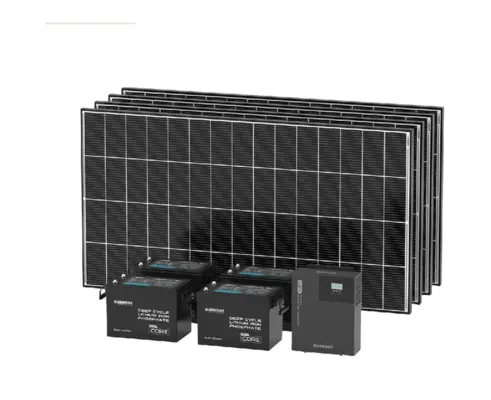 Renogy Cabin Solution — Complete Off-Grid Solar Kit →
Head to Head
| PWM | MPPT | |
|---|---|---|
| Harvest efficiency | ~70–80% of panel capability | ~93–99% |
| Cold-weather behavior | Excess voltage wasted | Excess voltage becomes charge current |
| Panel voltage flexibility | Must roughly match battery | Accepts high-voltage strings |
| Long wire runs | Thick cable required | Series strings, thin cable |
| Cost | $ | $$ — narrowing yearly |
| Sensible ceiling | ~200W arrays | Any size |
The Honest Case for PWM
PWM isn't a scam; it's a tool with a shrinking niche. It still makes sense when the array is tiny (a 50–100W trickle system keeping a battery topped), the budget is genuinely fixed and the alternative is no solar at all, or the application is temporary. In every one of those cases the arithmetic works because the absolute watts lost are small. The moment the array passes ~200W — or the site involves trees, cold, or a wire run — the lost harvest exceeds the controller savings within the first season, and MPPT becomes the cheap option wearing a higher sticker.
Choosing Your MPPT
Two numbers size an MPPT controller: output amps (array watts ÷ battery voltage × 1.25 — a 400W array on 12V wants ~40A) and max PV input voltage, which your string's cold-morning open-circuit voltage must stay under. Buy one size up on amps; the next panel is never optional. Model-by-model picks live in the best MPPT controllers guide; the two below cover most cabins:
Renogy Cabin Solution — Complete Off-Grid Solar Kit →
Renogy Rover 40A MPPT
Real tracking, correct lithium and AGM profiles, optional Bluetooth monitoring, and enough capacity for 400W on 12V or 800W on 24V — the single controller that covers the whole weekend-to-part-time cabin range.
Victron SmartSolar 100/30
Measurably superior tracking in cloud and cold, the best monitoring app in solar, and a five-year warranty. If the controller is the brain of the system, this is the one worth paying tuition for.
The Numbers on a Real Cabin: A Season-Long Comparison
Abstract percentages land differently as watt-hours, so run the comparison on the standard 400W weekend-cabin array. Through a PWM controller, that array's realistic daily delivery in 4.5 shoulder-season sun hours is roughly 1,300–1,400Wh once the voltage mismatch takes its cut. The same panels through a decent MPPT: 1,700–1,800Wh. The difference — call it 400Wh a day — is a 12V compressor fridge's better part of a day, every day, from identical hardware on the same roof. Across a six-month cabin season it's tens of kilowatt-hours, and in the marginal months it's frequently the difference between a bank that reaches full and one that never does. Price that against the controller cost gap and MPPT pays for itself within the first season on any array this size — which is why the honest framing isn't “is MPPT worth the premium” but “can this system afford to throw away a panel's worth of production.”
Common Misconceptions, Corrected
Three persistent myths deserve a direct answer. “MPPT only matters in cold climates” — cold amplifies the gap, but the baseline 20%+ advantage exists everywhere, because the panel-to-battery voltage mismatch exists everywhere. “A bigger PWM equals a small MPPT” — no; PWM's loss is structural, not a capacity problem, and no amp rating recovers voltage it's built to discard. “MPPT is complicated to set up” — the setup difference is one battery-profile menu, and modern units with Bluetooth apps are genuinely easier to commission and monitor than the dumb-simple PWMs they replace. The one legitimate PWM defense left standing is price at trickle scale, exactly as the guide's honest-case section says — everything else is inertia from an era when MPPT cost five times what it does now.
Frequently Asked Questions
Is MPPT really worth it over PWM?
For any array over about 200W, yes. MPPT harvests 20–30% more energy from the same panels — the equivalent of a free panel on a 400W array — with the biggest gains in cold weather and marginal light, which are precisely cabin conditions.
Why does a PWM controller waste power?
PWM connects the panel nearly directly to the battery, forcing the panel to operate at battery voltage instead of its power-producing sweet spot several volts higher. That voltage gap is production the panel physically cannot deliver through a PWM controller.
When is PWM still a good choice?
Small trickle systems under about 100–200W, where the absolute watts lost are tiny and the controller savings matter — keeping a battery topped at a shed, a gate opener, a temporary setup. Everywhere else, lost harvest overtakes the savings within a season.
Can I upgrade from PWM to MPPT later?
Yes, and it's one of the best-value upgrades in solar: swap the controller, set the battery profile, and the same array immediately delivers more. Check that your panel string's voltage fits the new controller's input window, and consider rewiring to series to exploit MPPT's high-voltage capability.
Does MPPT work with any battery?
Quality MPPT controllers support lead-acid, AGM, gel, and LiFePO4 through selectable or programmable charge profiles. The requirement is matching the profile to your battery's datasheet voltages — particularly for lithium, where the generic preset should be verified before first charge.