Winter Solar for Cabins: Cold-Weather Output & Battery Care
Affiliate disclosure: This page contains paid links to Amazon and eBay. If you buy through them, we may earn a commission at no extra cost to you. As an Amazon Associate I earn from qualifying purchases.
Winter is where cabin solar systems reveal what they're made of. The physics are a strange mix of bad news and good: days are short and the sun sits low, but cold panels are actually more efficient than hot ones, and snow on the ground can bounce meaningful extra light into the array. The component that genuinely suffers isn't the panel — it's the battery.
Here's what really happens to production in winter, how to keep the array working through snow, the battery rules that prevent permanent damage, and the two winterizing checklists: one for cabins occupied through the season, one for cabins left empty until spring.
What Winter Actually Does to Production
- Fewer, weaker sun hours. The dominant effect: northern-US winter delivers 2–4 peak sun hours against summer's 5–7. December production commonly runs one-third to one-half of June's.
- Cold panels work better. Panel voltage — and therefore output — rises as temperature falls. A crisp, clear 15°F day produces startlingly well per hour of sun. Cold isn't the enemy; darkness is.
- Snow albedo helps. Fresh snow reflects sunlight into tilted arrays, and bifacial panels on ground mounts harvest it from behind too — free winter production.
- Cold raises string voltage. The same effect that boosts output can push a series string past your controller's input ceiling on the coldest mornings. Check open-circuit voltage math against winter lows, not the spec-sheet 77°F number.
Net result: winter systems are limited by hours, not efficiency. Steeper tilt, generous array sizing, and clean panels claw hours back; nothing replaces them entirely — which is why the hybrid generator architecture exists.
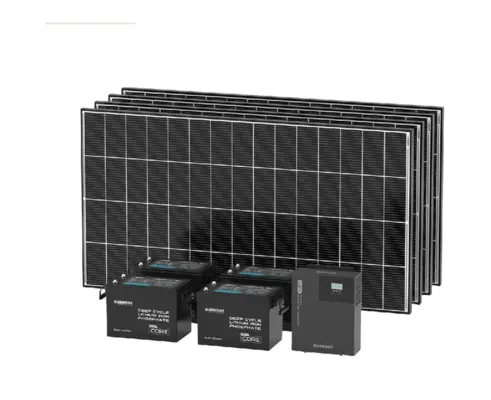 Renogy Cabin Solution — Complete Off-Grid Solar Kit →
Snow Management
A snow-covered panel produces essentially nothing, so removal strategy is production strategy:
- Tilt steep. Arrays at 50–60° shed most snowfalls on their own within a sunny day; shallow arrays hold it for weeks. Adjustable ground mounts earn their keep every winter.
- Sweep, never scrape. A soft foam roof rake clears panels without scratching glass or grinding grit into it. Metal tools and ice chipping are how warranties end.
- Ground mounts win winters. Thirty seconds with a broom at ground level versus a ladder on an icy roof — the maintenance difference alone justifies ground mounting in snow country.
- Leave stubborn ice alone. Bonded ice releases on the next sunny day; prying it off takes cells with it.
Snow Roof Rake with Foam Head
The one winter tool every snowbelt solar owner needs: a telescoping rake with a panel-safe foam head that clears the array from the ground. Thirty seconds after a storm restores full production without a ladder or a scratch.
The Battery Rules: Where Winter Does Real Damage
Panels shrug off cold; batteries don't. The rules by chemistry:
- LiFePO4 must not be charged below freezing. Discharging in the cold is fine (with reduced capacity); charging below ~32°F plates lithium onto the anode and permanently destroys capacity. Every winter lithium bank needs one of: placement inside the heated envelope, an insulated enclosure that holds daytime warmth, a battery with low-temperature charge cutoff, or a self-heating model that warms its own cells before accepting charge.
- AGM tolerates cold charging but loses usable capacity as temperature drops and charges best with a temperature-compensating controller sensor. Its cold-bluntness is the main reason AGM survives in unheated outbuildings.
- Everything charges slower and holds less in the cold. Whatever the chemistry, winter turns a comfortable bank into a snug one — part of why winter systems carry extra storage.
Placement beats gadgets: a bank inside the heated cabin, or in an insulated box against an interior wall, sidesteps the whole problem. The chemistry decision itself is covered in the lithium vs AGM comparison.
Renogy Cabin Solution — Complete Off-Grid Solar Kit →
LiTime 200Ah Self-Heating LiFePO4
The battery built for exactly this problem: internal heating pads warm the cells before the BMS allows charging, so an unheated cabin's bank survives winter untouched. For four-season cabins where the battery can't live indoors, this feature is the whole decision.
Winterizing Checklist: Occupied Cabin
- Steepen adjustable arrays to 50–60° for low sun and snow shedding.
- Confirm the battery bank's winter home — heated space, insulated box, or self-heating cells — before the first hard freeze.
- Verify the controller's temperature sensor is attached to the bank (AGM) or the low-temp cutoff is enabled (lithium).
- Re-torque every major connection; cold makes marginal connections fail.
- Stage the roof rake, and test the generator and its inverter-charger handoff before you need them in the dark.
Winterizing Checklist: Cabin Left Empty
- Charge the bank full, then decide: leave the system quietly float-charging (best if panels stay snow-free), or disconnect entirely.
- If disconnecting: lithium stores best around 50–60% charge in the cold; AGM stores full, and off a maintainer loses charge slowly all winter — plan a mid-winter top-up visit or accept spring recovery.
- Switch the inverter off — its idle draw will flatten an unattended bank in weeks.
- Remove or fuse-isolate every phantom load: sensors, chargers, that one forgotten radio.
- Photograph the controller history and settings on the way out; spring troubleshooting starts with knowing what “normal” looked like in November.
Designing for Winter From Day One
Retrofitting winter capability is always costlier than designing it in, so cabins with any four-season ambition should make four choices at the original build. Mount with adjustability or steep pitch — a 55° winter tilt is worth 20–30% of December production over a shallow summer angle, plus the snow-shedding. Oversize the array toward winter rather than the bank alone; panels are the cheap component, and winter's problem is income, not savings. Put the battery's winter home inside the thermal envelope on day one, with the power wall designed around it, rather than discovering the problem the first cold night. And wire the inverter-charger and generator inlet during the original build even if the generator comes later — the transfer architecture costs little as new work and a rewiring weekend as a retrofit. A cabin built this way treats winter as a design input instead of an annual emergency.
Reading Winter Production Data Like a Local
Winter rewards owners who watch the controller's history the way farmers watch weather. The patterns worth learning: your site's real December baseline (the number that tells you whether this week is normal-dark or trouble), the recovery signature of a clear post-storm day (cold, bright, snow-reflective days are winter's production heroes — often the best per-hour harvest of the season), and the slow creep of shading as the sun's arc drops week by week toward the solstice. A tree line that never touched the array in October can shade it half the day in January, and the production graph shows it as a sagging midday plateau long before you'd notice from the porch. One winter of attentive data turns into a personal almanac: you'll know your dark-stretch odds, your generator hours, and your true margins better than any calculator — and the second winter is planned instead of survived.
Frequently Asked Questions
Do solar panels work in winter at a cabin?
Yes — cold panels are actually more efficient per hour of sun than hot ones, and snow on the ground reflects extra light into the array. The real winter penalty is fewer sun hours: December production in the northern US typically runs one-third to one-half of summer's.
Can I charge lithium batteries in a cold cabin?
Not below freezing — charging LiFePO4 under about 32°F causes permanent capacity loss. Winter lithium banks need to live in heated space, in an insulated enclosure, or be models with low-temperature charge protection or self-heating cells that manage the problem internally.
How do I keep snow off cabin solar panels?
Tilt arrays steeply — 50–60 degrees sheds most snowfall on its own — and clear the rest with a foam-head roof rake from the ground. Never scrape with metal tools or chip ice; both damage the glass. Ground-mounted arrays make the whole chore a thirty-second broom job.
Should I disconnect my solar system if the cabin sits empty all winter?
Either leave it float-charging with the inverter off (ideal if the array stays snow-free) or disconnect fully — storing lithium around half charge and AGM full. The one non-negotiable is killing the inverter and phantom loads, which will otherwise drain the bank in weeks.
Why does my system produce so little in December?
Short days and a low sun angle cut peak sun hours to 2–4 in most northern regions, and any snow cover on panels drops production to nearly zero. If output is low even on clear days with clean panels, check for low-angle shading from trees that summer sun cleared easily.