Solar-Only vs Solar + Generator Hybrid for Cabins
Affiliate disclosure: This page contains paid links to Amazon and eBay. If you buy through them, we may earn a commission at no extra cost to you. As an Amazon Associate I earn from qualifying purchases.
Every off-grid cabin owner eventually meets the December problem: a week of low sun, short days, and snow-covered panels, with a battery bank that started the stretch full and won't finish it that way. There are exactly two solutions — build the solar system big enough to survive the worst dark stretch of the year, or keep a generator for those two weeks — and the right choice is arithmetic, not philosophy.
Here's the honest comparison: what solar-only really requires, how the hybrid architecture works, the winter math that usually decides it, and the setups that fit each kind of cabin.
The December Problem, Quantified
A system that covers your loads in June at 6 peak sun hours covers a third to half of them in December at 2–3 — before any snow sits on the array. Covering winter with solar alone means sizing the array and bank against the darkest occupied month plus a multi-day storm margin. In practice, that's an array two to three times summer's requirement and a battery bank with 3+ days of autonomy — hardware that runs at partial capacity the other ten months of the year.
The generator alternative covers those same worst stretches with a machine that runs a few dozen hours per winter. That asymmetry — thousands in standby hardware versus a modest machine and a jerry can — is the entire debate.
How the Hybrid Architecture Works
A proper hybrid isn't a generator sitting next to a solar system; it's an integration through an inverter-charger. The unit does three jobs: inverts battery DC to cabin AC like any inverter, passes generator power straight through to your outlets via an automatic transfer switch when the generator runs, and — the key part — uses that same generator input to recharge the battery bank at high current. Two hours of generator time on a dark day refills the bank and runs the cabin simultaneously; the generator then goes silent for days again.
The result: solar carries 90–95% of the year, the generator carries the December tail, and neither system is oversized for the other's job.
Renogy 3000W Inverter-Charger
The one component that turns solar-plus-a-generator into an actual hybrid system: 3,000W pure sine output, an automatic transfer switch, and a high-current charger that refills the bank whenever the generator runs. Plug the generator in; the architecture does the rest.
Honda EU2200i Inverter Generator
The quiet standard for cabin backup: clean inverter output safe for electronics, sips fuel at partial load, and starts after months of sitting. Sized to run the inverter-charger's charging current plus cabin basics — which is exactly its job description.
Head to Head
| Solar-Only | Solar + Generator Hybrid | |
|---|---|---|
| Array/bank sizing basis | Worst winter stretch | Average conditions |
| Hardware cost | $$$ — winter-sized everything | $$ — right-sized solar + modest generator |
| Noise & fuel | None, ever | A few dozen hours/winter |
| Failure resilience | One power source | Two independent sources |
| Maintenance | Nearly none | Generator oil, fuel rotation, test runs |
| Best fit | Sunny climates, seasonal cabins | Four-season northern cabins |
Who Should Go Solar-Only
Solar-only is genuinely right for three cabins: the seasonal cabin that's empty during the dark months (size for shoulder seasons and skip the problem entirely), the southern or high-desert cabin where winter sun stays generous, and the silence-first owner for whom no-engine-ever is the point and the extra array is a willingly-paid premium. If that's you, put the generator money into more storage and a steeper winter tilt — and read the winter solar guide for the production you can claw back.
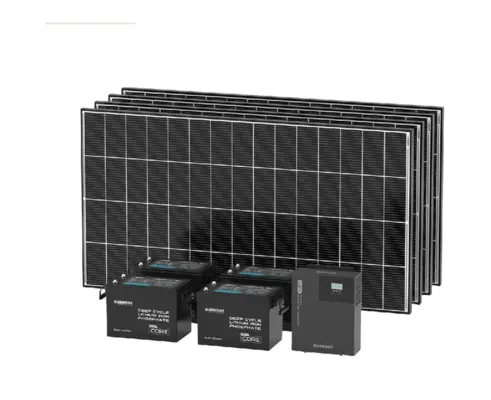 Renogy Cabin Solution — Complete Off-Grid Solar Kit →
The Verdict
For four-season cabins anywhere with real winter, the hybrid is the mature answer: solar right-sized to average conditions carries the overwhelming majority of the year, a small inverter generator covers the statistical tail, and the inverter-charger makes the handoff automatic. Solar-only wins where winter occupancy or winter darkness doesn't apply. Run your own numbers — winter loads through the sizing math, once assuming a generator and once not — and let the size gap between the two systems make the call. It usually does so loudly. For whole-cabin hybrid-ready systems in one shipment, see the complete kits guide.
Renogy Cabin Solution — Complete Off-Grid Solar Kit →
Generator Care: Keeping the Backup Actually Backed Up
A hybrid system is only as good as a generator that starts in the cold after three months of silence, and small inverter generators reward a simple discipline. Fuel is the whole game: untreated gasoline degrades in weeks, so run stabilizer in every can, rotate stock seasonally, and either run the carburetor dry before storage or feed the machine from fresh fuel each visit — carb varnish from stale gas is the cause of essentially all “it won't start” stories. Beyond fuel: a monthly test run under load (charging the bank counts, and puts the exercise to work), oil changes on the maintenance-hour schedule, and winter storage somewhere dry with the recoil accessible. Position the running generator outdoors, away from windows and vents — carbon monoxide is the one genuinely dangerous component in the entire hybrid architecture — and keep its extension to the inverter-charger's input rated for the full charging load. Twenty minutes a month keeps December boring, which is the entire point of the machine.
Frequently Asked Questions
Can a cabin run on solar alone in winter?
Yes, if the system is sized against the darkest occupied month — typically an array two to three times summer's requirement plus several days of battery autonomy. It's entirely achievable and entirely a cost question, which is why most four-season cabins pair solar with a small generator instead.
How big a generator does a solar cabin need?
Smaller than most people buy: it needs to power the inverter-charger's battery charging plus modest cabin loads, which a quiet 2,000–2,200W inverter generator handles for most systems. The generator is a battery-filler, not a whole-house power plant.
How often does the generator run in a hybrid setup?
In a well-sized hybrid, a few dozen hours per winter — typically two-hour charging runs during extended dark or snowy stretches. Many owners report entire months of silence outside the December-January window.
What makes an inverter-charger different from a regular inverter?
A regular inverter only converts battery DC to AC. An inverter-charger adds an automatic transfer switch that passes generator power through to your outlets, and a high-current charger that refills the bank from that same input — the two features that make a hybrid automatic instead of a manual juggling act.
Is a solar generator (power station) the same as a hybrid system?
No — a “solar generator” is a battery power station charged by panels, which is simply a portable solar-only system. A hybrid pairs solar with a fuel generator so two independent sources back each other up; the power station replaces neither the fuel generator's dark-week endurance nor a built system's capacity.