Lithium vs AGM Batteries for Cabin Solar: The Real Comparison
Affiliate disclosure: This page contains paid links to Amazon and eBay. If you buy through them, we may earn a commission at no extra cost to you. As an Amazon Associate I earn from qualifying purchases.
The lithium-versus-AGM question used to be a genuine debate; today it's mostly arithmetic with two important exceptions. LiFePO4 wins nearly every operating metric — usable capacity, cycle life, weight, charge speed, maintenance — while AGM keeps two cards that matter enormously to a specific kind of cabin: upfront cost and indifference to freezing temperatures.
Here's the full comparison with real numbers, the cost-per-kilowatt-hour math that settles the argument for most cabins, and the honest profile of the cabin where AGM is still the right call.
The Numbers That Matter
| LiFePO4 (Lithium) | AGM (Lead-Acid) | |
|---|---|---|
| Usable depth of discharge | 80–100% | ~50% |
| Cycle life | 3,000–5,000+ | 400–800 |
| Usable Wh per 100Ah @ 12V | ~1,000–1,200 | ~600 |
| Weight per usable kWh | ~25–30 lbs | ~110–130 lbs |
| Charge speed | Fast — takes full controller output | Slow absorption stage |
| Charging below 32°F | Prohibited (without heating/protection) | Tolerated |
| Partial-charge sitting | Harmless — prefers it | Sulfates and degrades |
| Maintenance | None | Charge discipline required |
| Upfront cost | $$ | $ |
Read the first two rows together and the story is over for most buyers: to get the usable capacity of one 100Ah lithium battery you need roughly two 100Ah AGMs — and you'll replace those AGMs several times before the lithium retires.
Cost Per Stored Kilowatt-Hour: The Only Fair Math
Sticker price compares purchase moments; cost per delivered kilowatt-hour compares the batteries. A LiFePO4 bank delivering ~90% of capacity across 3,500+ cycles stores each kilowatt-hour for a fraction of what an AGM bank does delivering 50% across 600 cycles — commonly a three-to-five-fold advantage over the batteries' lives, despite lithium's higher entry price. AGM's economics only compete when the battery will see few cycles: a cabin visited a handful of weekends a year may retire an AGM bank by calendar age before cycle life ever matters, which flips the math back toward the cheaper sticker.
Cold Weather: AGM's Last Stronghold
Lithium's one hard limitation: charging below freezing permanently damages LiFePO4 cells. Solutions exist — banks inside the heated envelope, insulated enclosures, low-temperature charge cutoffs, self-heating models — and the winter solar guide covers all of them. But every solution is a decision someone has to make and maintain, and AGM simply doesn't care: it charges in an unheated shed at 10°F, slowly and grumpily, without damage. For a bare-bones unheated outbuilding with a trickle system and nobody watching, that bluntness is a genuine feature.
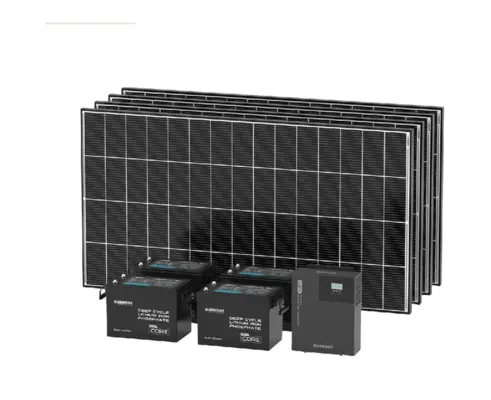 Renogy Cabin Solution — Complete Off-Grid Solar Kit →
The Picks, Both Ways
Renogy 200Ah Core LiFePO4
The default cabin bank: 200Ah of LiFePO4 with a solid BMS, parallel expansion, and thousands of cycles. One battery runs a weekend cabin; two or three build the part-time bank; the chemistry's usable-capacity advantage does the rest.
Renogy 100Ah AGM Deep Cycle
Where AGM still makes sense: lowest entry cost, sub-freezing charge tolerance, and zero fuss in an unheated building. Half the usable capacity and a fraction of the cycles — a rational trade for the lightly-used cold shack it suits.
LiTime 200Ah Self-Heating LiFePO4
The battery that erases AGM's last advantage: internal heating warms the cells before the BMS permits charging, so lithium survives an unheated four-season cabin. If cold was your reason for AGM, this is the counter-argument.
The Verdict
Lithium for: any cabin used regularly, any full-time system, anyone who values charge speed and zero maintenance, and — with self-heating or indoor placement — cold climates too. AGM for: tight budgets on rarely-used systems, unheated buildings where nobody will manage a battery's winter, and trickle-charge duty where cycle life never gets tested. If you're still torn, run your bank size through the sizing math both ways — needing twice the rated AGM capacity to hit the same usable target usually ends the debate on its own.
Renogy Cabin Solution — Complete Off-Grid Solar Kit →
The Switching Question: When to Retire an AGM Bank
Thousands of cabins run aging AGM banks bought when lithium was exotic, and the switch timing has a clean answer: replace on failure or at the capacity cliff, not before. AGM degrades gradually and then suddenly — the tell is a bank that charges to full voltage but sags fast under evening loads, meaning usable capacity has quietly halved. When that day comes, the swap to lithium is usually painless: modern MPPT controllers already carry LiFePO4 profiles (verify absorption voltage against the new battery's datasheet), the physical footprint shrinks dramatically, and the inverter needs only a low-voltage-cutoff check. Two genuine gotchas: an old PWM controller with no lithium profile should be replaced in the same project (see the MPPT explainer — the harvest gain sweetens the deal), and a bank that lives in an unheated space needs the cold-weather plan settled before the first freeze, not after. Most owners report the same verdict post-switch: the capacity they thought they had is the capacity they finally have.
Renogy Cabin Solution — Complete Off-Grid Solar Kit →
Frequently Asked Questions
Is lithium really worth the extra cost for a cabin?
For any regularly-used cabin, yes: LiFePO4 delivers roughly double the usable capacity per rated amp-hour and five to ten times the cycle life, making its cost per stored kilowatt-hour a fraction of AGM's despite the higher purchase price.
Can AGM batteries handle freezing cabin winters better than lithium?
For charging, yes — AGM tolerates sub-freezing charging that damages unprotected LiFePO4 permanently. Lithium closes the gap with indoor placement, low-temperature cutoffs, or self-heating models, but plain AGM's indifference to cold remains its strongest surviving argument.
How much AGM capacity equals one lithium battery?
Roughly double: AGM should only be discharged to about 50% while LiFePO4 delivers 80–100%, so matching a 200Ah lithium bank's usable energy takes around 400Ah of rated AGM — with several times the weight and a fraction of the lifespan.
Can I replace AGM batteries with lithium in an existing system?
Usually yes, with two checks: the charge controller must offer a proper LiFePO4 profile (most modern MPPTs do), and the bank must stay above freezing for charging. Confirm the inverter's low-voltage cutoff suits lithium's flatter discharge curve as well.
How long does each chemistry actually last at a cabin?
LiFePO4 typically delivers 3,000–5,000 cycles — a decade or more of daily use, and far longer at weekend duty. AGM manages 400–800 cycles at 50% depth of discharge and also ages by calendar and charge discipline, commonly needing replacement in 3–6 cabin years.