Best Solar Battery Banks for Cabins (2026)
Affiliate disclosure: This page contains paid links to Amazon and eBay. If you buy through them, we may earn a commission at no extra cost to you. As an Amazon Associate I earn from qualifying purchases.
Panels get the attention, but the battery bank is where your cabin's quality of life actually lives. Storage determines whether the lights stay on through a cloudy stretch, whether the fridge survives your week away, and whether the system you bought this year still satisfies the cabin you'll have in five. It's also, watt-hour for watt-hour, the most expensive part of the system — which makes choosing well matter more here than anywhere else.
Below: how to size a cabin bank in three lines of math, the LiFePO4 batteries we trust in 2026, the cold-weather picks for unheated buildings, and where AGM still earns a place.
Sizing Your Bank in Three Lines
Line 1: daily consumption in watt-hours (from your load list — the sizing math guide if you need it).
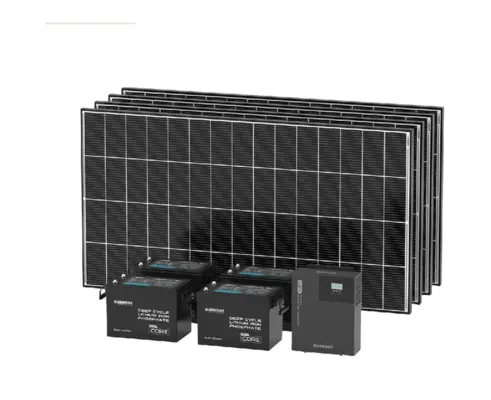 Renogy Cabin Solution — Complete Off-Grid Solar Kit →
Line 2: multiply by days of autonomy — 1.5 days is a comfortable minimum, 2–3 for cloudy climates.
Renogy Cabin Solution — Complete Off-Grid Solar Kit →
Line 2: multiply by days of autonomy — 1.5 days is a comfortable minimum, 2–3 for cloudy climates.
Line 3: divide by usable depth of discharge — 0.9 for LiFePO4, 0.5 for AGM.
Example: a 2,000Wh/day cabin wanting two days of autonomy on lithium needs 2,000 × 2 ÷ 0.9 ≈ 4,450Wh — call it a 4.5–5kWh bank, or two 200Ah 12V LiFePO4 batteries in parallel. The same target on AGM would require roughly 8,000Wh of rated capacity, which is the quiet reason lithium wins most cabin math despite the sticker difference.
Best Cabin Battery Banks
Renogy 200Ah Core LiFePO4
The cabin storage default: 200Ah of LiFePO4 with a solid internal BMS, parallel expansion support, and clean integration with Renogy charging gear. One covers a weekend cabin; two or three build a part-time bank; the chemistry delivers thousands of cycles either way.
Battle Born 100Ah GC3 LiFePO4
The battery with the reputation: assembled and supported in the US, a ten-year warranty, and a BMS with years of proven field behavior. You pay for the name — and get the strongest support experience in the category, which matters when the bank is the priciest thing in the power wall.
LiTime 200Ah Low-Temp LiFePO4
LiFePO4 must not be charged below freezing — and this battery solves it internally, with low-temperature protection and a self-heating variant that warms cells before accepting charge. For unheated cabins that see real winter, this feature isn't a luxury; it's the difference between a battery and a brick.
Renogy 100Ah AGM Deep Cycle
AGM's case in 2026: lowest upfront cost, tolerance for sub-freezing charging that lithium can't match without heaters, and total indifference to sitting partially charged in a cold building. Half the usable capacity per rated Ah and a fraction of the cycle life — but for a lightly-used, unheated shack, still a rational pick.
EcoFlow Delta Pro Portable Power Station
Storage, inverter, charging, and monitoring in one carryable unit — 3.6kWh of LiFePO4 expandable with extra batteries, charged from portable panels or a wall outlet at home before you drive up. The premium buys the absence of an electrical project.
Lithium vs AGM: The Cabin Verdict
LiFePO4 wins on every operating metric — double the usable capacity per rated amp-hour, five to ten times the cycle life, half the weight, faster charging, zero maintenance — and its higher sticker price amortizes into the cheapest cost per stored kilowatt-hour by a wide margin. AGM's two surviving advantages are upfront cost and cold-charging tolerance. If your cabin is heated when occupied or your battery has low-temp protection, lithium is the answer; the full argument is in our lithium vs AGM comparison, and cold-climate placement strategy is covered in the winter solar guide.
Renogy Cabin Solution — Complete Off-Grid Solar Kit →
Bank-Building Rules That Prevent Regret
- Match everything. Parallel identical batteries — same model, same age. Mixed banks equalize to the weakest member.
- Equal cable lengths on paralleled batteries so they share current evenly; unequal runs quietly overwork one battery.
- Set the charge profile. Your controller must charge at the battery datasheet's voltages — the generic “lithium” preset is usually close but verify absorption voltage.
- Keep lithium above freezing for charging. Inside the heated envelope, an insulated box, or a self-heating model. Charging frozen LiFePO4 permanently damages cells.
- Leave room to parallel. Buy a model with documented parallel support and cable your power wall so battery #2 is a thirty-minute add, not a rebuild.
Understanding the BMS: The Battery Inside the Battery
Every LiFePO4 battery contains a battery management system — a circuit board that balances the cells, enforces charge and discharge limits, and disconnects the battery to protect itself. BMS quality is the real difference between premium and bargain lithium, and it's invisible on the spec sheet. What good looks like: a continuous discharge rating that comfortably exceeds your inverter's draw (a 100A BMS cannot feed a 2,000W/12V inverter's ~170A — this mismatch is the most common lithium buying error), low-temperature charge protection that physically blocks charging below freezing, cell balancing that keeps the pack healthy over years, and documented parallel support with a stated maximum unit count. Bluetooth BMS monitoring, where offered, is genuinely useful rather than a gimmick — per-cell voltages and cycle counts are the battery's medical chart. When two batteries share a chemistry and a price, the BMS documentation is the tiebreaker.
Wiring the Bank: Parallel, Series, and the Balance Problem
How batteries connect matters as much as which batteries. Parallel (positive-to-positive, negative-to-negative) adds capacity at the same voltage — the standard cabin growth path — but demands discipline: identical models of similar age, equal-length interconnect cables, and system takeoffs from diagonal corners of the bank (positive from the first battery, negative from the last) so charge and load spread evenly instead of hammering the nearest unit. Series (positive-to-negative) stacks voltage for 24V and 48V systems from 12V units; series strings of lithium should be built from batteries the manufacturer rates for series use, since their BMS units can't balance across each other. Whichever topology, torque every terminal to spec with a real wrench, use proper lugs rather than bare wire under bolts, and re-check after the first month — bank connections carry the highest currents in the entire cabin, and a loose one announces itself as heat.
Battery Placement and the Long Off-Season
Where the bank lives shapes its lifespan. The ideal spot is inside the cabin's thermal envelope, off the floor, ventilated, and close to the controller and inverter — a closet or under-bench cabinet near the power wall. Lithium needs no venting for gases (unlike flooded lead-acid) but appreciates stable temperatures; AGM tolerates cold but charges better warm. For cabins that sit empty, the off-season routine from the winter guide applies: lithium stores happiest around half charge with the system disconnected, AGM stores full, and in both cases the inverter and every phantom load must be genuinely off. A bank that winters correctly loses almost nothing; one left feeding a forgotten load spends the dark months grinding toward the deep discharge that shortens every chemistry's life. The disconnect switch you installed on day one earns its place every November.
Renogy Cabin Solution — Complete Off-Grid Solar Kit →
For a cabin without permanent wiring — or as silent backup alongside a panel system — an all-in-one LiFePO4 power station covers lights, devices, and small appliances with no installation. Charge it from a portable panel during the day, run the cabin at night.
Frequently Asked Questions
How big a battery bank does a cabin need?
Multiply daily watt-hour consumption by 1.5–3 days of autonomy, then divide by usable depth of discharge (about 0.9 for lithium, 0.5 for AGM). A typical 2,000Wh/day cabin lands at a 4–6kWh lithium bank — commonly two 200Ah 12V batteries in parallel.
Is lithium worth it over AGM for a cabin?
For any cabin used regularly, yes: LiFePO4 delivers roughly double the usable capacity per rated amp-hour and five to ten times the cycle life, making it cheaper per stored kilowatt-hour despite the higher purchase price. AGM remains sensible for rarely-used, unheated buildings on tight budgets.
Can lithium batteries freeze at a cabin?
LiFePO4 can safely sit and discharge below freezing, but charging below about 32°F causes permanent damage. Cold-climate cabins should keep the bank inside the heated space, use batteries with low-temperature charge protection or self-heating, or both.
How many batteries can I connect in parallel?
Most quality LiFePO4 models document a parallel limit — commonly four units — set by the BMS design. Stay within the manufacturer's stated limit, use identical batteries, and keep cable lengths equal so the bank shares current evenly.
How long do cabin solar batteries last?
Quality LiFePO4 delivers 3,000–5,000+ cycles — a decade or more of daily cabin use, longer with weekend-only duty. AGM typically manages 400–800 cycles at 50% depth of discharge, which is why it usually gets replaced twice before a lithium bank retires once.