Cabin Solar Sizing: Watts, Battery & Load Math Explained
Affiliate disclosure: This page contains paid links to Amazon and eBay. If you buy through them, we may earn a commission at no extra cost to you. As an Amazon Associate I earn from qualifying purchases.
Every component in a cabin solar system is sized from one number: your daily energy consumption. Get that number right and the rest of the system falls out of four short calculations — array, battery, controller, inverter. Get it wrong and no amount of hardware spending fixes the mismatch.
This guide runs the complete math once, in order, on a single realistic cabin, so you can substitute your own numbers line by line. No shortcuts, no “rules of thumb” that hide the reasoning — just the actual arithmetic.
Step 1: The Load Audit
List every electrical load, its wattage (from the nameplate or a plug-in meter), and honest daily hours. Our example cabin — part-time, three-season, two people:
| Load | Watts | Hours/Day | Daily Wh |
|---|---|---|---|
| LED lighting (8 fixtures) | 72 | 5 | 360 |
| 12V compressor fridge | 45 avg | 24 | 1,080 |
| Water pump | 60 | 0.5 | 30 |
| Laptop + phone charging | 80 | 3 | 240 |
| Fan | 40 | 5 | 200 |
| Radio / small electronics | 25 | 4 | 100 |
| Total | 2,010 Wh/day |
Two audit rules: use average watts for cycling loads like fridges (they run the compressor maybe a third of the time), and add 10% at the end for the loads you forgot. Ours: 2,010 × 1.1 ≈ 2,200Wh/day design load.
Step 2: Array Watts
Array = Daily Wh ÷ Peak Sun Hours × 1.3.
Our cabin sits in the Midwest and gets used April through October — shoulder-season sun of about 4.5 hours is the conservative basis. So: 2,200 ÷ 4.5 × 1.3 ≈ 635W. Standard hardware rounds that to a 600W array (acceptably close) or 800W (comfortable margin, and margin always gets used). We'll spec 800W: eight 100W panels or four 200W panels.
Step 3: Battery Bank
Bank Wh = Daily Wh × Days of Autonomy ÷ Usable Depth of Discharge.
Autonomy is how long the cabin runs with no sun. We'll choose 2 days — a sane Midwest minimum. On LiFePO4 (90% usable): 2,200 × 2 ÷ 0.9 ≈ 4,890Wh. In 12V terms that's about 400Ah: two 200Ah LiFePO4 batteries in parallel. The same target on AGM (50% usable) would demand nearly 9,800Wh of rated capacity — four times the batteries — which is the arithmetic behind lithium's takeover of cabin storage.
Step 4: Charge Controller
Controller amps = Array W ÷ Bank V × 1.25.
800W into a 12V bank: 800 ÷ 12 × 1.25 ≈ 83A — which is past common controller sizes and a hint that the bank wants to be 24V. At 24V: 800 ÷ 24 × 1.25 ≈ 42A — a 40–50A MPPT fits cleanly, cables shrink, and losses drop. This is the classic decision point: systems above ~500W of array are usually happier at 24V. (Our battery pick simply becomes two 200Ah 12V units in series instead of parallel.) Controller picks by size are in the MPPT guide.
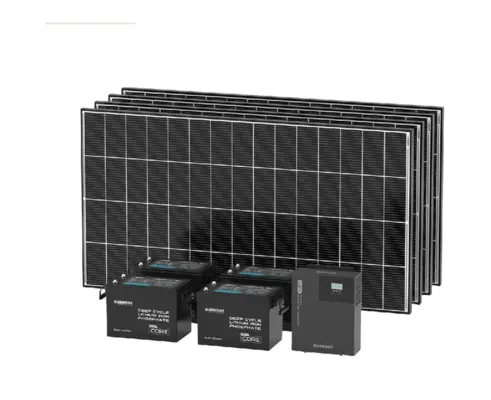 Renogy Cabin Solution — Complete Off-Grid Solar Kit →
Step 5: Inverter
The inverter sizes to peak simultaneous load, not daily consumption. Our cabin's realistic worst moment: fridge compressor start (~400W surge) + microwave (1,000W) + lights and electronics (200W) ≈ 1,600W momentary. A 2,000W pure sine inverter with 4,000W surge covers it with headroom. Confirm the inverter accepts 24V input to match the bank.
Renogy 2000W Pure Sine Inverter (24V)
The size and voltage our example lands on: honest 2,000W continuous, 4,000W surge for compressor starts, pure sine output, and 24V input to match the bank the math chose. Most part-time cabins converge on exactly this class of inverter.
The Finished Spec Sheet
| Component | Spec | Derived From |
|---|---|---|
| Design load | 2,200Wh/day | Load audit + 10% |
| Array | 800W (8 × 100W) | Load ÷ 4.5 sun hrs × 1.3, rounded up |
| Bank | ~5kWh LiFePO4, 24V | Load × 2 days ÷ 0.9 |
| Controller | 40–50A MPPT | Array ÷ 24V × 1.25 |
| Inverter | 2,000W pure sine, 24V | Peak simultaneous load + surge |
Substitute your own load audit into line one and the whole sheet recalculates. If you'd rather buy the answer than assemble it, the complete kits guide maps these system sizes to matched packages, and the setup guide takes over on install day.
Renogy Cabin Solution — Complete Off-Grid Solar Kit →
Stress-Testing the Design: Three Questions Before You Buy
A finished spec sheet deserves three adversarial questions. What does the worst week look like? Run the bank math against two fully dark days followed by a half-production day — if the model ends with the bank below 20%, either add storage or accept that a generator is part of the design. What happens when loads grow? Re-run the sheet at 130% of your design load, because that's where most cabins land within two years; if the answer requires replacing the controller or inverter rather than adding panels and batteries, buy the bigger controller now. What single failure hurts most? In the example system it's the controller — one unit between the entire array and the bank — which is why experienced off-gridders keep a cheap backup PWM controller in a drawer: crude, but it keeps the fridge cold while the real replacement ships. Ten minutes of pessimism at the spreadsheet stage is the cheapest resilience you'll ever buy.
From Spec Sheet to Shopping List
Translating the finished spec into orders has its own small pitfalls. Panels: buy the array as one order of one model — mixed panels complicate wiring and warranties. Battery: confirm the model's BMS continuous discharge rating exceeds the inverter's maximum draw at your bank voltage, the compatibility check most often missed. Controller: verify both the amp rating from the sheet and the PV input voltage window against your planned string layout, cold-adjusted. Inverter: match input voltage to the bank and confirm surge covers the worst motor start. Then add the unglamorous line items the sheet implies but doesn't name — battery cable and lugs, fuses and holders at every rating the wiring guide specifies, a disconnect switch, and a shunt monitor. The accessories run a tenth of the budget and determine whether the other nine-tenths performs.
Renogy Cabin Solution — Complete Off-Grid Solar Kit →
Frequently Asked Questions
What's the correct order for sizing a cabin solar system?
Load audit first, always: daily watt-hours drive everything. Then array watts (load ÷ sun hours × 1.3), battery capacity (load × autonomy days ÷ usable depth of discharge), controller amps (array ÷ bank voltage × 1.25), and finally inverter size from peak simultaneous load.
How many days of battery autonomy should a cabin have?
Two days is the comfortable standard for most climates; sunny regions can run 1.5, and chronically cloudy ones justify 3. More autonomy than that usually costs more than adding a small generator for the rare long stretch.
When should a cabin system be 24V instead of 12V?
Once the array passes roughly 500W or the inverter passes 2,000W. Higher bank voltage halves the current for the same power, which shrinks controller size, cable gauge, fuses, and losses. Systems at whole-cabin scale go 48V for the same reason.
How much should I oversize my solar array?
The 1.3 loss factor in the formula is the baseline oversize — it covers real-world losses. Beyond that, rounding up to the next standard array size (600W to 800W, say) is cheap insurance, since panels are the least expensive component per watt and loads only grow.
Can I skip the math and just buy a kit?
You can skip assembling components, but not the load audit — a kit that doesn't match your daily watt-hours fails exactly like a mismatched custom build. Run steps one and two, then shop kits whose array and storage meet your numbers.