Best Inverters for Off-Grid Cabins (2026)
Affiliate disclosure: This page contains paid links to Amazon and eBay. If you buy through them, we may earn a commission at no extra cost to you. As an Amazon Associate I earn from qualifying purchases.
The inverter is where your solar system meets your actual life: every AC appliance in the cabin runs through it, every start-up surge tests it, and its idle draw quietly taxes your battery all night. Choose well and you never think about it again. Choose badly and you get humming fridges, tripped overloads, and mystery battery drain.
Here's how to size an off-grid cabin inverter correctly, the pure sine wave models we recommend from small to whole-cabin, and when an inverter-charger is worth the upgrade.
Inverter Sizing: Surge Is the Spec That Bites
Size against your largest simultaneous load, not daily consumption. Add up what could realistically run at once, then check the surge rating against the biggest motor start — fridge compressors and well pumps briefly draw two to three times their running watts.
| Cabin Profile | Continuous Need | Recommended Inverter |
|---|---|---|
| Lights, charging, small electronics | Under 600W | 1,000W pure sine |
| + full-size fridge, microwave OR coffee maker | 1,200–1,800W | 2,000W pure sine |
| + well pump, multiple kitchen loads | 2,000–2,800W | 3,000W pure sine / inverter-charger |
Two non-negotiables: pure sine wave output (modified sine damages compressor motors and electronics over time), and honest continuous ratings — reputable brands rate conservatively; bargain listings rate optimistically.
Best Off-Grid Cabin Inverters
Renogy 2000W Pure Sine Inverter
The right size for most cabins and built like it: honest 2,000W continuous with 4,000W surge, clean pure sine output, LCD status, and solid protection circuits. Runs a full-size fridge plus lights plus a laptop without breaking stride, and pairs naturally with Renogy controllers and batteries.
Victron Phoenix 1200VA
For cabins with modest AC needs, the Phoenix is the efficiency king: excellent low-load efficiency, a genuinely useful ECO mode that sips power waiting for loads, and Victron's five-year warranty. If your biggest AC draw is a coffee maker, this is the graceful answer.
GIANDEL 2200W Pure Sine
A consistently well-reviewed budget pure sine unit with a remote switch, dual outlets, and hardwire terminals. It lacks the ecosystem polish of the big names but delivers honest wattage — the pick when the budget went to panels and batteries first.
Renogy 3000W Inverter-Charger
The whole-cabin answer: 3,000W of pure sine output plus a built-in transfer switch and battery charger, so a generator or shore hookup passes through and recharges the bank automatically. This one component turns a solar cabin into a hybrid-power cabin — the standard architecture for four-season living.
AIMS 3000W Low-Frequency Inverter
Low-frequency design with a real transformer means enormous surge capacity — the pick for cabins with a stubborn well pump or workshop compressor whose start-up trips high-frequency inverters. Heavy, industrial, and unbothered by motor loads.
Inverter vs Inverter-Charger
A plain inverter converts DC to AC. An inverter-charger adds two features that transform a full-time cabin: an automatic transfer switch that passes generator/shore power straight through to your outlets, and a powerful battery charger that refills the bank from that same input. Run the generator for two hours on a dark December day and the inverter-charger handles everything — no rewiring, no manual switching, no separate charger.
Weekend cabins rarely need one. Four-season and full-time cabins almost always end up wanting one — see the solar + generator hybrid guide for how the pieces fit.
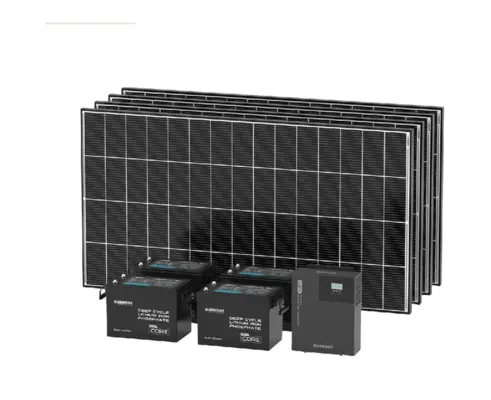 Renogy Cabin Solution — Complete Off-Grid Solar Kit →
Installation Notes That Save Batteries
- Short, fat cables. A 2,000W inverter on 12V can draw close to 200A — that demands seriously thick cable, kept under a few feet, with a properly sized fuse at the battery end.
- Ventilation. Inverters shed real heat under load; give them airflow and never build them into a sealed cabinet.
- Switch it off when away. Idle draw over a week of absence can meaningfully drain a small bank. A remote switch by the door makes it a habit.
- Consider 24V or 48V for 3,000W-class systems — higher bank voltage quarters the current, shrinking cables, fuses, and losses. The wiring guide covers the trade-offs.
Renogy Cabin Solution — Complete Off-Grid Solar Kit →
High-Frequency vs Low-Frequency Inverters: What the Weight Means
Pick up two 3,000W inverters and one might weigh three times the other — that's the high-frequency versus low-frequency divide, and it matters for cabins. High-frequency units (most modern consumer inverters, including the Renogy and GIANDEL picks above) use electronic switching: light, compact, efficient, affordable, with surge capacity around double their continuous rating — ample for typical cabin loads. Low-frequency units (the AIMS pick) build around a massive iron-core transformer: heavy and pricier, but with brutal surge capability of three times continuous or more, and serene indifference to the ugly start-up demands of well pumps, compressors, and big motors. The rule of thumb: if your worst load is a fridge and a microwave, high-frequency serves perfectly; if a 240V well pump or workshop compressor is in the picture, the transformer's weight is exactly what you're paying for. Neither is “better” — they're tuned for different worst moments.
Where the Inverter Meets the Cabin's Wiring
There are two clean ways to distribute inverter output, and choosing deliberately avoids the extension-cord archaeology that haunts old cabins. The simple path: plug loads and power strips into the inverter's outlets directly — fine for one-room cabins with few AC loads. The proper path: hardwire the inverter into a small AC breaker panel feeding the cabin's outlet circuits, exactly like a tiny house service. The hardwired route requires respecting the inverter's neutral-ground bonding instructions (off-grid inverters differ on whether they bond internally — the manual is law here) and is the point where having an electrician sanity-check the work is cheap wisdom even for a committed DIYer. If a generator will ever join the system, this is also the moment to choose an inverter-charger and wire its transfer switch into the panel once, rather than re-plumbing the cabin's AC later.
Sizing Mistakes That Show Up as Mystery Problems
Three inverter mistakes masquerade as other faults. Oversizing looks harmless but taxes the bank daily: a 3,000W unit idles hungrier than a 1,000W unit, and running one at 5% load all evening wastes meaningful storage — size to your real loads, not your aspirations. Undersized battery cable presents as an inverter problem — alarms and shutdowns under load — when the actual fault is voltage sag in thin or long cables; the fix is copper, not a new inverter. And ignoring surge on motor loads produces the classic “it runs everything except the well pump” complaint; motors demand two to three times their running watts for a moment at start, and the inverter's surge rating, not its continuous rating, decides that moment. Budget cable and surge properly and the inverter becomes what it should be: the component you forget about.
Frequently Asked Questions
What size inverter do I need for an off-grid cabin?
Add up your largest simultaneous AC loads and buy above that with surge headroom: 1,000W covers lights and electronics, 2,000W handles a full-size fridge plus normal cabin life, and 3,000W suits full-time living with a well pump or bigger kitchen loads.
What's the best small inverter for a cabin?
The Victron Phoenix line is the standout small inverter — excellent efficiency at low loads and an ECO standby mode that barely sips power while waiting. For most basic cabins, a quality 1,000W pure sine unit covers everything a small system should be running anyway.
Pure sine wave or modified sine wave for a cabin?
Pure sine wave, always. Modified sine inverters make compressor motors run hot and loud, shorten appliance life, and misbehave with electronics and anything with a control board. The price gap has narrowed to the point where modified sine no longer makes sense.
Why is my inverter draining the battery overnight?
Idle draw. Most inverters consume 10–25W simply being on, which adds up to hundreds of watt-hours overnight. Switch it off when not needed, use an ECO/standby mode if yours has one, and run overnight loads like a 12V fridge directly off DC instead.
Do I need an inverter-charger or just an inverter?
If you'll ever connect a generator, an inverter-charger is worth it: it automatically passes generator power to your outlets and recharges the battery bank through the same unit. Weekend cabins with no generator plans are fine with a plain pure sine inverter.