Best Solar Panels for Cabins (2026): Rigid, Small-Cabin & Log Cabin Picks
Affiliate disclosure: This page contains paid links to Amazon and eBay. If you buy through them, we may earn a commission at no extra cost to you. As an Amazon Associate I earn from qualifying purchases.
Panels are the most-shopped and least-differentiated part of a cabin solar system — until you put them on a real cabin site, where shade tolerance, physical size, and mounting details suddenly separate the good from the merely rated. A cabin roof isn't a suburban roof: it's smaller, often steeper, frequently ringed by trees, and sometimes made of logs that demand different mounting thinking.
Here are the panels we recommend for cabin duty in 2026, why cell architecture matters more on wooded sites than spec sheets suggest, and what changes when the building under the array is a log cabin.
What Actually Matters in a Cabin Panel
- Monocrystalline, full stop. Better output per square foot and better low-light performance than polycrystalline — and cabin roofs are short on square feet.
- Cell architecture. More busbars (9BB, 10BB) and half-cut cell designs lose less output to the partial shading that tree-ringed cabin sites serve up all day.
- Physical size per watt. Two 100W panels fit odd roof faces better than one 200W slab. Small cabins often mount around vents, chimneys, and dormers.
- Frame and warranty. Anodized aluminum frames, sealed junction boxes, and a 25-year output warranty from a manufacturer likely to outlive it.
- Voltage behavior. If you'll wire panels in series for a long run to the cabin, check open-circuit voltage against your controller's input ceiling — cold mornings push voltage up.
Best Cabin Solar Panels of 2026
Renogy 100W Monocrystalline Panel
The default building block of cabin solar for a decade running: dependable output, a tough anodized frame, standard connectors, and a 25-year output warranty. Buy one for a shed or eight for a full-time array — they stack cleanly either way.
BougeRV 200W 9BB Panel
Nine-busbar architecture keeps current flowing around shaded cells instead of collapsing the whole panel's output. On a cabin site with moving tree shadows, that's routinely worth more real energy than an extra rated 50W of standard panel.
Rich Solar 200W Panel
Fewer, bigger panels mean fewer mounts, fewer connections, and faster installs on a clear south-facing roof. Rich Solar's 200W mono is the workhorse pick when your roof is open and your goal is watts per dollar.
Renogy 200W Bifacial Panel
Bifacial cells harvest reflected light from the back face — meaningful gains over snow, light gravel, or a reflective ground surface. On an open ground mount at a cabin, winter snow-bounce is free production exactly when you need it most.
HQST 100W Compact Panel
A compact, honest 100W mono panel at consistently friendly pricing. Ideal for odd roof spaces, first systems, and anywhere you're adding a panel or two to an existing array without hunting for premium features.
Solar Panels for Log Cabins
Log cabins raise two specific issues. First, mounting: log purlin-and-rafter roofs vary wildly in structure, and metal roofing over logs is common — S-5 style standing-seam clamps or purlin-anchored rails beat generic asphalt-shingle lag mounts, and every penetration needs generous sealing because log structures move seasonally as moisture content changes. Second, shade: log cabins overwhelmingly sit in trees. Prioritize 9BB/half-cut panels, wire in shorter series strings (or parallel) so one shaded panel doesn't drag a whole string down, and seriously consider a ground mount in the nearest clearing — a 50-foot cable run at higher string voltage costs almost nothing.
Structure uncertain? Weigh the array (roughly 15–20 lbs per 100W panel plus rails — light by roofing standards) but have anyone with an older or hand-built log roof sanity-check the purlin spans before drilling.
Panels for Small Cabins: Fit Beats Rated Watts
On a small cabin roof, the binding constraint is usually area and obstruction layout, not budget. Sketch the roof with its vents and chimney, then choose the panel size that tiles it best — often that's 100W units, even though 200W panels are cheaper per watt. A 400W array that actually fits and clears shade out-produces a 600W plan that never quite gets installed. Pair your layout with the panel-count guide to land on the right total wattage.
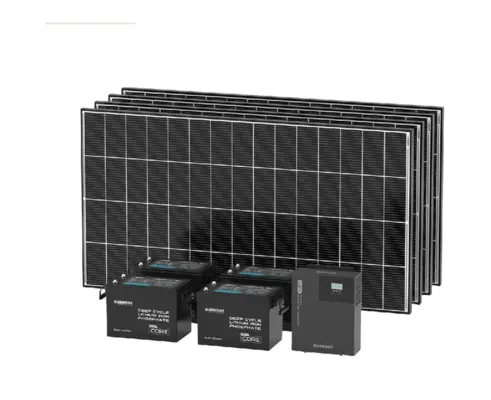 Renogy Cabin Solution — Complete Off-Grid Solar Kit →
Wiring Your Panels: Series, Parallel, or Both
Series wiring adds voltage, shrinks cable size, and suits long runs — but shade on one panel throttles the string. Parallel wiring adds current, tolerates shade well, and suits short runs — but demands thicker cable and per-string fusing. Most cabin arrays land on series-parallel hybrids: pairs of panels in series, pairs paralleled together. Check your MPPT controller's voltage window and let it, not habit, decide the topology. The wiring guide has worked examples.
Renogy Cabin Solution — Complete Off-Grid Solar Kit →
Reading a Panel Spec Sheet in Ninety Seconds
Four lines on the datasheet do all the work. Rated power (Pmax) is laboratory output at 77°F and perfect sun — expect 70–85% of it in the field, from every brand, and treat it as a comparison unit rather than a promise. Open-circuit voltage (Voc) is the number your charge controller cares about: your string's summed Voc, increased 10–20% for cold mornings, must stay under the controller's input ceiling. Temperature coefficient tells you how output falls as panels heat — around -0.3%/°C is good, -0.4% ordinary — and matters most for hot-climate and rooftop-mounted arrays where panels run far above air temperature. The warranty pair — product warranty (build quality, typically 10–12 years) and performance warranty (output floor, typically 25 years at 80%+) — separates manufacturers betting on their panels from those betting on your patience. Everything else on the sheet is engineering detail the controller absorbs for you.
Panel Care: The Five-Minute Seasonal Routine
Panels are the lowest-maintenance component you'll ever own, but they're not zero-maintenance. Production drifts down as pollen, dust, and bird traffic accumulate — a few percent in clean rural air, more under trees or near fields. The routine: rinse with plain water and a soft brush on a pole a few times a season, early morning so cold water never hits hot glass, no soap, no pressure washer, never a scraper. Inspect while you're there: check for cell discoloration, junction-box cracks, and connector corrosion, and confirm the mounting hardware hasn't loosened with the roof's thermal cycling. In snow country, add the foam roof rake ritual from the winter guide. That's the entire maintenance manual for a 25-year asset.
Renogy Cabin Solution — Complete Off-Grid Solar Kit →
Used and Surplus Panels: Worth It?
The secondary market — decommissioned commercial panels, storm-claim surplus, outlet-store returns — offers panels at fractions of retail, and for the right buyer they're a legitimate play. The rules: buy panels you can visually inspect or that come from an outlet store with a return path; check for cell browning, snail trails, delamination at the edges, and cracked backsheets; and expect honest degradation of a half-percent per year of age, so a ten-year-old panel delivering ~95% of a comparable new unit's output at a steep discount is a fine deal. What kills the math is shipping (freight on a few used panels can erase the savings) and mystery-condition pallet lots. For a first small array, new panels' warranties are worth the premium; for expanding an existing system with known hardware, clean used panels are the value-per-watt champion.
Frequently Asked Questions
How many solar panels does a cabin need?
Divide your daily watt-hour consumption by local peak sun hours, add ~30% for system losses, and divide by panel wattage. A typical weekend cabin using 1,500Wh a day in a 4-sun-hour location needs roughly 500W — five 100W panels or three 200W panels.
Are flexible solar panels good for cabins?
Generally no. Flexible panels trade lifespan and heat tolerance for bendability that cabin roofs don't need. Rigid monocrystalline panels last decades longer, run cooler, and cost less per watt — save flexible panels for curved RV and boat surfaces.
What are the best solar panels for a log cabin?
Shade-tolerant 9BB or half-cut monocrystalline panels, mounted with hardware suited to the actual roof — standing-seam clamps on metal, purlin-anchored rails otherwise. Given how many log cabins sit under trees, a ground mount in a clearing is frequently the highest-producing option.
Do solar panels work in the shade?
They work poorly — even partial shading can cut a standard panel's output by half or more, and a shaded panel in a series string drags down the whole string. Multi-busbar and half-cut panels limit the damage, and parallel wiring isolates it, but no panel technology beats simply finding sun.
Can I mix different solar panels on one cabin?
You can mix within reason: panels with matching voltage specs can share a parallel array, and matching current specs can share a series string. Mismatched panels drag each other to the weaker spec. When expanding, the cleanest result comes from adding the same model — or giving mismatched panels their own controller.