Cabin Solar Kit Buying Guide: How to Choose the Right System
Affiliate disclosure: This page contains paid links to Amazon and eBay. If you buy through them, we may earn a commission at no extra cost to you. As an Amazon Associate I earn from qualifying purchases.
Search for “solar kits for cabins” and you'll find everything from a single 100W panel with a controller to pallet-sized systems with 20kWh of lithium storage — all called “kits.” The word tells you almost nothing. What matters is what's actually in the box, whether the components are matched to each other, and whether the whole package is matched to your cabin's loads.
This guide breaks down the kit market the way we wish someone had broken it down for us: the three kinds of kits being sold, how to read a kit listing like a spec sheet instead of an ad, which size fits which cabin, and the specific kits we'd actually put on our own buildings in 2026.
The Three Kinds of “Solar Kits” Being Sold
Every cabin solar kit on the market falls into one of three buckets, and knowing which one you're looking at instantly clarifies the price and what you still need to buy:
- Panel + controller kits (most common). Panels, a charge controller, mounting brackets, and cables. No battery, no inverter. These are the “400W solar kit” listings that seem like a bargain — because the two most expensive components aren't included. Great if you already have storage, misleading if you don't.
- Panel + controller + battery kits. Adds a lithium or AGM battery, giving you a complete DC system out of the box. Add an inverter and you're running AC appliances. A solid middle path.
- Complete off-grid systems. Panels, storage, and an inverter or inverter-charger, all pre-matched. One purchase, one warranty relationship, one set of instructions. The most expensive sticker but frequently the best value per usable watt-hour, and by far the fewest opportunities to buy mismatched parts.
How to Read a Kit Listing Like a Spec Sheet
Six things determine whether a kit is any good. Check them in this order:
- Panel type and count. Monocrystalline is the standard — better output per square foot and better low-light behavior than polycrystalline. Newer N-type mono cells add efficiency and slower degradation.
- Controller type and amperage. MPPT harvests 20–30% more than PWM, especially in cold and cloud. The controller's amp rating also caps your future expansion: a 40A MPPT on 12V tops out around 500W of panels no matter how many you bolt on later.
- Battery chemistry and usable capacity. Rated amp-hours mislead: 100Ah of AGM gives roughly 50Ah usable; 100Ah of LiFePO4 gives 80–100Ah. Compare usable watt-hours.
- Inverter output and waveform. Pure sine wave, always. Continuous rating should cover your simultaneous loads; surge rating should cover compressor start-ups.
- Wiring and fusing. Good kits include correctly-gauged cables, connectors, and fusing. Kits that skip fuses are telling you something about the engineering care level.
- Expandability. Can the controller take more panels? Can the battery parallel with more units? A kit you can grow beats a kit you'll replace.
Match the Kit to the Cabin: A Sizing Cheat Sheet
| Cabin Type | Typical Daily Use | Kit Size | Storage | Inverter |
|---|---|---|---|---|
| Shed / hunting shack (lights + charging) | 300–600Wh | 100–200W | ~1kWh | Optional, 300–1,000W |
| Weekend cabin (+ 12V fridge, fan) | 1,000–1,800Wh | 300–400W | 2–3kWh | 1,000–2,000W |
| Part-time cabin (+ full fridge, pump) | 2,000–3,500Wh | 600–800W | 4–6kWh | 2,000–3,000W |
| Full-time cabin / homestead | 4,000–8,000Wh+ | 1,500–3,000W | 10–20kWh | 3,000W+ split-phase optional |
Two adjustments to the table: if you'll use the cabin through winter, move up one size class — winter sun hours are brutal. And if any load involves an electric motor starting under load (well pump, big compressor), size the inverter's surge rating against it specifically.
Our Kit Picks by Cabin Type
These picks reflect what's consistently well-reviewed, well-supported, and sanely engineered in 2026 — the same shortlist we maintain on our kits page.
Renogy 100W Starter Kit
The classic entry point: one 100W mono panel, a 30A controller, brackets, and connectors. Keeps a battery topped up so lights and devices always work — and the controller leaves room to grow to 400W of panels later.
ECO-WORTHY 200W Complete Kit
Two 100W panels with a 30A controller and mounting hardware — the cheapest sane path onto solar for a basic cabin. Runs LED lighting, phone and tool charging, and a small 12V fridge with careful use.
Renogy 400W Premium Kit
Four mono panels and a 40A MPPT controller with Bluetooth monitoring. The sweet spot for weekend and part-time cabins: real daily production, real harvest efficiency, and app-level visibility into what your system is doing.
BougeRV 300W 9BB Kit
Nine-busbar cells tolerate shade and low light noticeably better than standard panels — worth real money on tree-ringed cabin sites where the array catches moving shadows all day.
Rich Solar 800W Off-Grid Kit
Eight panels and a 60A MPPT controller — a genuine full-time array. Add 5–10kWh of lithium and a 3,000W pure sine inverter and this runs a real household: full-size fridge, pump, lights, and electronics with margin.
The One-Purchase Option: Complete Off-Grid Systems
If your goal is a full-time cabin and you'd rather make one decision than seven, complete systems that ship panels, lithium storage, and an inverter-charger together are the cleanest path. Everything is voltage-matched at the factory, the wiring diagram covers the exact hardware in the crate, and warranty support is one phone call.
Renogy Complete Off-Grid Cabin Solution
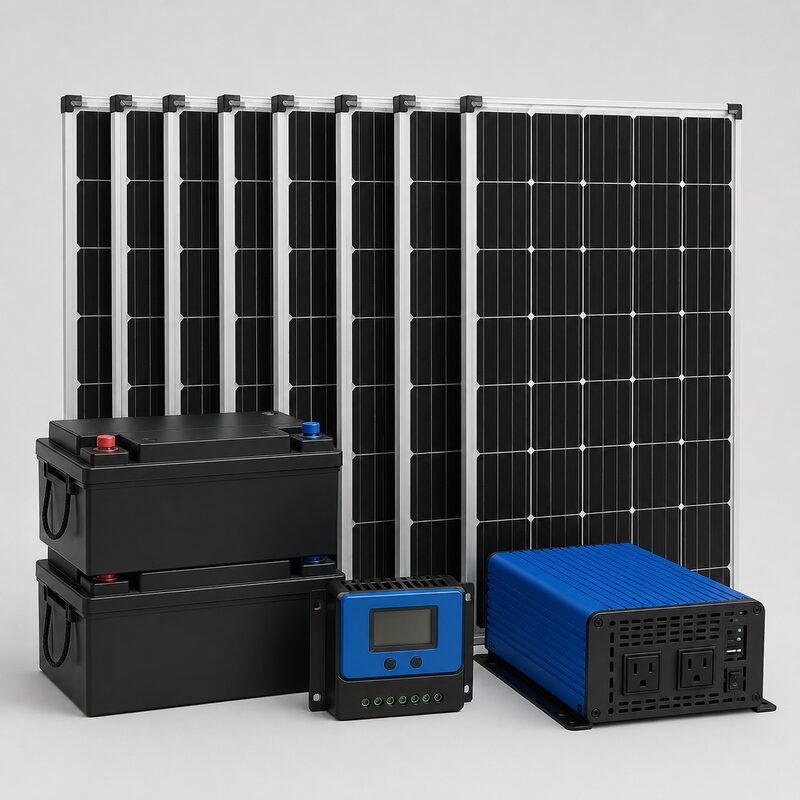
A serious all-in-one package for full-time cabins and workshops — high-efficiency N-type panels, an expandable LiFePO4 battery bank rated at 20.48kWh, and a 3,500W pure sine wave inverter-charger, shipped as one pre-matched kit so nothing gets mismatched.
See Live Price at Renogy →Direct from Renogy — we may earn a commission at no extra cost to you.
Systems at this scale typically arrive freight, so have a plan for unloading, and check that the inverter's output configuration (single-phase vs split-phase) matches how your cabin is wired.
Kit Red Flags to Avoid
- No-name panels with no warranty document. Quality mono panels carry 25-year output warranties from companies that will exist in 25 years.
- “1000W kit” headlines describing the inverter, not the panels. A classic listing trick: a 100W panel bundled with a 1,000W inverter, marketed on the bigger number.
- PWM controllers on 400W+ arrays. At that scale the harvest losses exceed the controller savings within the first season.
- Modified sine wave inverters in “complete” kits. An instant tell that the kit was built to a price, not to run your fridge for a decade.
- Missing fuses and undersized cable. If the kit skimps where safety lives, assume it skimps everywhere you can't see.
After the Kit Arrives: Setup in Four Steps
- Bench-test before mounting. Wire the system on the ground on a sunny day and confirm charging works before anything goes on a roof.
- Mount panels for winter sun. True south, tilted near your latitude — steeper if winter matters. See our roof installation guide.
- Keep controller-to-battery runs short. Long panel runs are fine at higher voltage; the low-voltage battery side is where cable losses bite.
- Fuse every positive conductor at the source end — panel string, controller output, inverter feed. Our wiring guide has the full diagram.
Sizing still fuzzy? Run your numbers through the sizing math guide or the site-wide sizing guide before you click buy — it's the cheapest hour you'll spend on this project.
Where People Actually Buy Kits — and What Changes by Channel
The same kit often exists in three places at meaningfully different terms. Buying direct from the manufacturer (Renogy, Rich Solar, ECO-WORTHY all sell direct) typically gets the newest revisions, bundle configurators, and the cleanest warranty registration; watch their holiday sales, which are genuine. Amazon offers speed and painless returns — valuable for a first system where you might mis-order — and frequently matches direct pricing. eBay is the sleeper channel: manufacturer outlet stores sell open-box and previous-revision kits at real discounts, and panels in particular lose nothing meaningful between revisions. For a budget build, a previous-generation kit from an official outlet store is one of the best value plays in cabin solar.
Whichever channel, buy the whole electrical chain at once if you can. Piecemeal purchases across months are how systems end up with a controller from one voltage era and panels from another — and how shipping damage gets discovered after return windows close. Order together, unbox together, bench-test together.
Unboxing and Bench-Testing: The First Hour Matters
Before anything touches a roof, test the kit as a system on the ground. Lay the panels flat in the yard, wire the controller to a battery, connect the array, and confirm three things: the controller recognizes the battery and reports sane voltage, the array produces meaningful current in sun, and every connector mates cleanly. This hour catches shipping-damaged panels (look for cell cracks and scuffed junction boxes), miscounted hardware, and DOA electronics while they're still trivially returnable — and it teaches you the system's behavior at ground level, where troubleshooting is comfortable, instead of on a ladder.
Photograph the serial numbers and register warranties the same day. Panel warranties run twenty-five years; the receipt will not survive that long in a drawer, but a photo in your email will.
A Realistic First-Year Upgrade Path
Almost nobody's first kit is their final system, and the good news is the upgrade path is predictable. The typical sequence: the first season reveals that storage, not panels, is the binding constraint — evenings end earlier than expected — so year one's upgrade is a second battery in parallel. The second discovery is the value of monitoring, so a shunt-based battery monitor follows. Panel additions come third, usually one or two units up to the controller's ceiling. The controller itself is the last thing replaced, and only when the array outgrows it — which is exactly why this guide keeps repeating the advice to buy controller headroom on day one. A kit chosen with a 40A MPPT instead of the 30A the starting array strictly needed turns this whole path into plug-in weekends instead of re-engineering.
Budget emotionally for this path too: the cabin that gets solar gets more solar. Loads migrate from propane and hauled batteries onto the system as trust grows, and the system that seemed generous in June feels snug by October. That's not failure; that's adoption.
Kit Brands, Honestly Ranked by What They're Good At
The cabin kit market has consolidated around a handful of names, each with a distinct personality worth knowing before you shop. Renogy is the ecosystem play: the widest product line, the best app and monitoring experience, strong documentation, and mid-tier pricing — the safe default for a first system and the reason so many recommendations here wear the badge. Rich Solar competes on watts per dollar with straightforward, robust hardware and fewer frills; its larger kits are the value route to full-time scale. ECO-WORTHY owns the budget tier honestly — components are basic but genuine, and its bundled kits with storage included are some of the cheapest complete systems that actually work. BougeRV differentiates on panel technology, with multi-busbar cells that legitimately outperform in shade. Victron doesn't sell cabin kits at all, but its controllers and inverters are what experienced builders graduate to — the premium component layer above the kit world. Match the brand's personality to your priorities and the shortlist builds itself.
One meta-rule across all of them: buy the current or immediately-previous product generation. Solar hardware iterates quickly, and a three-generation-old kit at a mild discount usually trades away meaningful controller and monitoring improvements for very little savings.
The Pre-Purchase Checklist
Before clicking buy on any kit, run this final gate: your load audit says the array covers your daily watt-hours in the worst month you'll occupy the cabin; the controller has at least 25–30% amp headroom over the included array for expansion; battery storage — included or planned — meets your autonomy target with the right chemistry for your winter; the inverter (included or planned) is pure sine wave and clears your largest simultaneous load with surge margin; the mounting hardware matches your actual roof material; and the vendor's warranty explicitly supports self-installation. Six yes answers and the kit is right. Any no is cheaper to fix in the cart than on the power wall.
Frequently Asked Questions
What size solar kit do I need for a small cabin?
Most small cabins do well with 200–400W of panels, 2–3kWh of lithium storage, and a 1,000–2,000W pure sine wave inverter. That runs LED lighting, device charging, a fan, and a 12V fridge. If you add a full-size fridge or use the cabin full-time, step up to 600–800W.
Do cabin solar kits come with batteries?
Many don't. The most common kits include only panels, a charge controller, and mounting hardware — you add storage and an inverter separately. Complete off-grid systems that include lithium storage and an inverter exist at every scale but are labeled and priced accordingly. Always read the included-components list.
Is a Renogy kit better than building my own system?
For a first system, a pre-matched kit from Renogy, Rich Solar, or ECO-WORTHY is usually the better call: components are voltage-matched, cables are correctly sized, and support covers the whole package. Custom builds win once you have experience and specific requirements the kits don't cover.
MPPT or PWM for a cabin kit?
MPPT for anything over about 200W of panels. It converts excess panel voltage into charging current, harvesting 20–30% more energy than PWM — the gap widens in cold weather and partial sun, exactly the conditions cabins face.
Can I expand a solar kit later?
Usually, within limits. The charge controller's amp rating caps total panel wattage, and your battery chemistry determines whether you can parallel more storage. Buy a controller with 30–50% headroom over your starting array and expansion stays a weekend job instead of a rebuild.
How long does a cabin solar kit last?
Panels are warrantied for 25 years and typically outlast that. LiFePO4 batteries deliver roughly 3,000–5,000 cycles — a decade or more of daily use. Controllers and inverters are the usual first replacements, generally after 8–15 years.