Best Complete Off-Grid Solar Kits for Cabins (2026)
Affiliate disclosure: This page contains paid links to Amazon and eBay. If you buy through them, we may earn a commission at no extra cost to you. As an Amazon Associate I earn from qualifying purchases.
There's a moment in every cabin solar project where the spreadsheet of individually-chosen components starts to feel like a liability: will the controller's voltage window really accept that string? Is the inverter cable in the cart the right gauge? Complete off-grid kits exist for exactly that moment — systems where the panels, storage, charging, and inverter were engineered together, shipped together, and warrantied together.
Here are the complete systems we recommend in 2026, from weekender packages to whole-cabin power plants, and how to tell a genuinely complete kit from a panel bundle wearing the label.
What “Complete” Should Actually Mean
A real complete off-grid kit includes all four component groups: panels, a charge controller (or hybrid inverter with charging built in), battery storage, and a pure sine inverter — plus correctly-gauged cabling and fusing between them. Plenty of listings market “complete kits” that stop at panels and controller. Before comparing anything, confirm the box contains storage and an inverter; those two items typically represent more than half the total system cost.
The other mark of a real system: the components reference each other. The controller's charge profile matches the included battery's chemistry, the inverter's input matches the bank voltage, and the manual describes this exact combination rather than generic hookups.
Best Complete Off-Grid Kits
ECO-WORTHY 800W Complete Kit with Lithium
One of the few true all-in-one packages at a friendly price: 800W of panels, MPPT charging, LiFePO4 storage, and a pure sine inverter in a single order. Component quality is honest rather than premium, but everything matches, and for a part-time cabin it simply works out of the box.
Renogy 800W Kit + 200Ah Lithium Bundle
Renogy's 800W array and Rover MPPT charging paired with their 200Ah LiFePO4 storage — a matched ecosystem with the best monitoring and support experience in the category. Add a 2,000W pure sine inverter and this comfortably runs a part-time cabin with a real fridge.
Rich Solar 1600W Complete Off-Grid System
A sixteen-panel, 1,600W array with high-capacity MPPT charging sized for genuine full-time loads. Paired with a 10kWh-class lithium bank, it runs a household: full kitchen, pump, lights, electronics, and cloudy-day margin that smaller systems can't offer.
EcoFlow Delta Pro + 400W Panel Bundle
The zero-wiring path: a 3,600W power station with LiFePO4 storage inside, charged by portable panels. No mounting, no fusing, no commissioning — carry it in, plug in the panels, done. Cost per watt-hour is higher than a built system, but for rented cabins or renovation-phase power it's unbeatable.
The Whole-Cabin Flagship
At the top of the category sits the configuration for cabins replacing a utility connection outright — a 2,500W-class N-type array, 20.48kWh of expandable lithium storage, and a 3,500W inverter-charger, engineered and shipped as one system:
Renogy Complete Off-Grid Cabin Solution
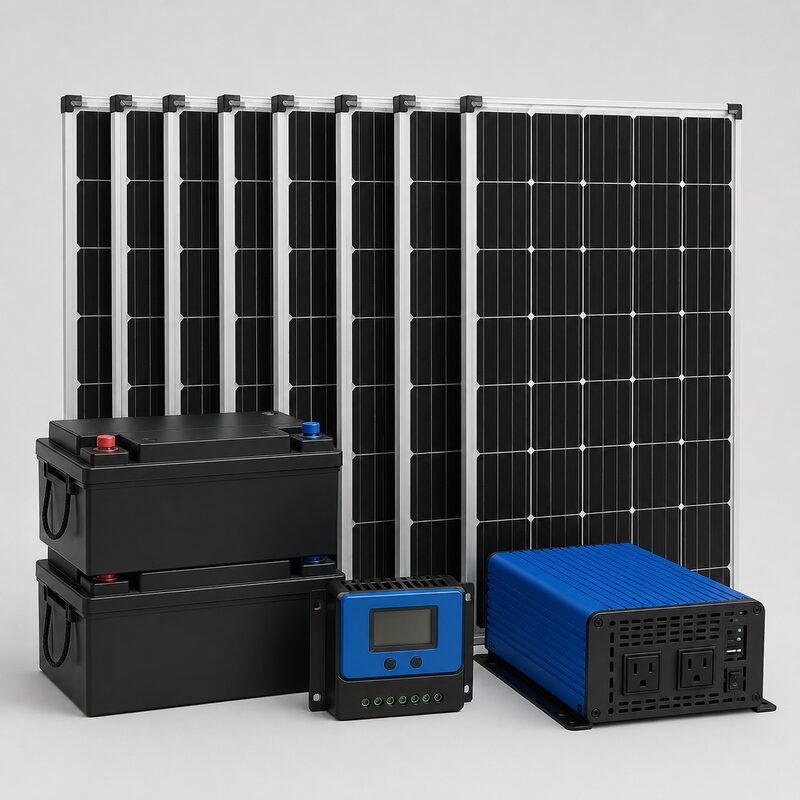
A serious all-in-one package for full-time cabins and workshops — high-efficiency N-type panels, an expandable LiFePO4 battery bank rated at 20.48kWh, and a 3,500W pure sine wave inverter-charger, shipped as one pre-matched kit so nothing gets mismatched.
See Live Price at Renogy →Direct from Renogy — we may earn a commission at no extra cost to you.
Systems at this scale arrive freight and deserve a day of planning: where the battery cabinet lives, how the array feed enters the cabin, and whether output should be wired single-phase or split-phase for your panel. The setup guide walks the whole commissioning sequence.
Matching Kit Scale to Cabin Life
| You Are | Daily Load | Right-Sized System |
|---|---|---|
| Weekends, three seasons | 1,000–1,800Wh | 400–800W array, 2–3kWh storage, 2,000W inverter |
| Part-time, some winter | 2,000–3,500Wh | 800W array, 4–6kWh storage, 2,000–3,000W inverter |
| Full-time, four seasons | 4,000–8,000Wh | 1,600–2,600W array, 10–20kWh storage, 3,000W+ inverter-charger |
Winter is the multiplier people miss: December production in the northern US can be a third of June's. Full-time systems get sized against winter sun hours — or paired with a generator through an inverter-charger, which is usually the cheaper path. The weekend vs full-time guide runs the numbers both ways.
Complete Kit or Component Build?
Complete kits win on compatibility, warranty simplicity, and time — the engineering risk is the manufacturer's, not yours. Component builds win on flexibility and best-in-class parts (a Victron controller here, a premium battery there) at the cost of your own diligence. First system, or a system someone else will maintain? Kit. Third system, unusual site, or strong opinions about controllers? Build. The full comparison makes the case both ways.
Delivery Day: What Arriving Freight Actually Looks Like
Complete systems ship on pallets via freight carriers, which is a different experience from a parcel on the porch. Expect a delivery appointment call, a liftgate truck (confirm liftgate service when ordering — some quotes assume a loading dock), and curbside delivery, meaning the pallet lands at the end of your driveway, not in the cabin. Plan the last hundred feet: a helper, a hand truck, and dry staging space for boxes that may sit through a build weekend. Inspect before signing — count boxes against the packing list and photograph any crushed corners or punctures, noting damage on the delivery receipt, because freight claims live and die by that signature. Panels deserve particular attention: a cracked cell from shipping is invisible from three feet and shows up as a string underperforming forever. Ten careful minutes at the truck protects the whole purchase.
The Commissioning Weekend: A Realistic Timeline
A complete kit compresses the build dramatically, but plan a real weekend, not an afternoon. Day one is mechanical: mounting rails and panels (the roof work in the installation guide), routing the array feed, and placing the battery cabinet and inverter where they'll live. Day two is electrical, in the strict order the setup guide details: bank, controller or inverter-charger to bank, AC output, and the array connected last, followed by the commissioning checklist — verify charge profile, watch the first real charging hour, add loads one at a time. Complete kits earn their price on day two: where a component build spends hours resolving whose manual wins an ambiguity, the kit's single manual describes the exact hardware on your wall. First-timers routinely finish by Sunday dinner.
Warranty and Support: The Part You're Actually Buying
The quiet case for complete systems is what happens in year three when something misbehaves. With a matched kit, one vendor owns the whole diagnosis — there's no panel maker blaming the controller maker blaming your wiring, because they're all the same support ticket. Protect that advantage on day one: register every serialized component, photograph the settings screens after commissioning, and keep the freight and purchase documents in the same email folder. When you call support, production history from the system's monitoring app is the evidence that turns a vague complaint into a fast resolution. And check the warranty's fine print on one point specifically: whether self-installation affects coverage. The kits recommended here are explicitly DIY-supported — that's part of why they're recommended — but the confirmation costs one search of the warranty PDF.
Frequently Asked Questions
What does a complete off-grid solar kit for a cabin include?
A genuinely complete kit includes panels, a charge controller (or hybrid inverter), battery storage, a pure sine inverter, and the cabling and fusing between them. Many kits labeled complete stop at panels and controller — always verify storage and an inverter are on the included list.
How big should an off-grid kit be for full-time cabin living?
Most full-time cabins land between 1,600W and 2,600W of panels with 10–20kWh of lithium storage and a 3,000W-class inverter-charger. The right number comes from your winter daily consumption, since December production is a fraction of summer's.
Are complete kits cheaper than buying components separately?
Usually comparable, sometimes slightly better — bundling discounts offset the convenience premium. The real savings are in avoided mistakes: no mismatched voltages, no wrong-gauge cables, no incompatible charge profiles, and one warranty covering everything.
Can a complete kit be expanded later?
Good ones, yes. Check three headrooms before buying: the controller or hybrid inverter's maximum PV input, the battery's parallel expansion support, and the inverter's continuous rating relative to your loads. Systems with expandable lithium banks are specifically designed for staged growth.
Do complete kits include installation hardware?
Panel mounting hardware is usually included; what varies is roof-type compatibility — kits typically assume standard rail mounts, so metal or log-structure roofs may need different attachments. Battery enclosures, disconnect switches, and conduit are almost never included and are worth budgeting separately.