Weekend Cabin vs Full-Time Living: How Much Solar You Really Need
Affiliate disclosure: This page contains paid links to Amazon and eBay. If you buy through them, we may earn a commission at no extra cost to you. As an Amazon Associate I earn from qualifying purchases.
The distance between “solar for weekend trips” and “solar for living here” is bigger than most cabin owners expect — and it isn't a straight line. Some loads scale gently with occupancy; others appear suddenly and dominate the whole system. Understanding which is which lets you buy the weekend system that grows gracefully, or the full-time system that isn't three sizes too small.
Here's how consumption actually changes across the occupancy spectrum, the three load thresholds that reset your system size, and right-sized system specs for each way of using a cabin.
The Three Thresholds That Reset Your System
- The refrigerator threshold. A cabin without refrigeration runs on a few hundred watt-hours a day; add a 12V fridge and you've roughly tripled consumption — permanently, 24 hours a day, whether you're there or not. This is the jump from a 200W system to a 400W+ system.
- The full-kitchen threshold. Full-time life brings the household fridge, more cooking, more laundry, more hours of everything. Daily consumption doesn't creep — it doubles or triples again. This is the jump to 800W+ arrays and multi-kilowatt-hour storage.
- The winter threshold. The occupancy change that costs the most: staying through December means sizing against 2–4 peak sun hours instead of 5–6, and it converts a comfortable summer system into a starving one. Full-time four-season cabins size to winter or add a generator — usually both conversations happen together.
Consumption by Lifestyle: Real Numbers
| Lifestyle | Occupancy | Daily Wh | Driving Loads |
|---|---|---|---|
| Weekend basic | 2–6 days/mo, 3 seasons | 400–800 | Lights, charging, fan |
| Weekend + fridge | 4–8 days/mo | 1,200–2,000 | 12V fridge (24/7), lights, devices |
| Part-time | 1–2 wks/mo, shoulder seasons | 2,000–3,500 | Real fridge, pump, longer evenings |
| Full-time, 3 seasons | Living there | 3,500–6,000 | Full kitchen, laundry, work-from-cabin |
| Full-time, 4 seasons | Living there, winter incl. | 4,000–8,000 against winter sun | All of the above at 2–4 sun hrs/day |
Note what happens between rows two and three, and again into winter: consumption grows maybe 2x, but the system grows more, because storage days and winter sun both stack multipliers on top.
Right-Sized Systems for Each Lifestyle
- Weekend basic: 200W array, ~1–2kWh storage, small pure sine inverter. Set-and-forget.
- Weekend + fridge: 400W array, 2–3kWh lithium, 1,000–2,000W inverter. The most popular cabin system in America for a reason — and the fridge keeps running between visits.
- Part-time: 600–800W array, 4–6kWh lithium, 2,000W inverter. Comfortable margin, cloudy-day resilience.
- Full-time, 3 seasons: 1,200–1,600W array, 8–12kWh lithium, 3,000W inverter-charger.
- Full-time, 4 seasons: 2,000W+ array sized to winter sun, 15–20kWh storage, 3,000W+ inverter-charger, and a backup generator for the dark stretches — the hybrid architecture covered in the solar + generator guide.
Renogy 400W Premium Kit
The system the weekend-plus-fridge lifestyle converges on: 400W of mono panels, a 40A MPPT with Bluetooth so you can check on the fridge from home, and headroom for the part-time future. Add lithium storage and an inverter and it's done.
Going Full-Time: The One-System Answer
Owners making the jump to full-time living face a choice: upgrade the weekend system piece by piece (new controller, doubled array, tripled storage, bigger inverter — each with compatibility questions) or step to a whole-cabin system engineered as one unit. At full-time scale, the one-system route is usually cleaner:
Renogy Complete Off-Grid Cabin Solution
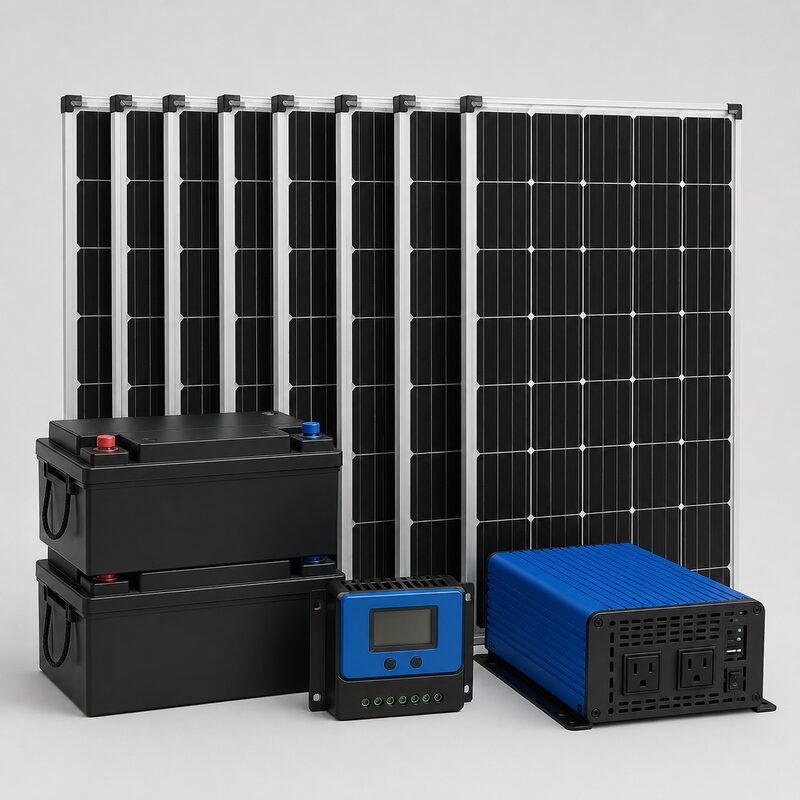
A serious all-in-one package for full-time cabins and workshops — high-efficiency N-type panels, an expandable LiFePO4 battery bank rated at 20.48kWh, and a 3,500W pure sine wave inverter-charger, shipped as one pre-matched kit so nothing gets mismatched.
See Live Price at Renogy →Direct from Renogy — we may earn a commission at no extra cost to you.
Buying for the Cabin You'll Have
The cheapest path through this whole spectrum is honest forecasting. If there's any realistic chance the weekend cabin becomes the retirement cabin, spend the small premiums that keep doors open: an MPPT controller with amp headroom, a battery model with parallel expansion, a bank voltage (24V) that supports a bigger future inverter, and conduit runs with room for more copper. Those choices cost little now and save a rebuild later. Run your actual numbers with the sizing math guide — once for today's cabin, once for the five-year version — and buy the components where the two answers overlap.
The Transition Year: What Actually Changes When You Move In
Owners who make the jump report the same discoveries in the same order. First, hours: loads you metered honestly as a visitor run two and three times longer when the cabin is home — lights, laptops, the pump, all of it. Second, winter stops being optional: the season you used to skip becomes the season you live in, and the system meets 2-sun-hour days for the first time. Third, the appliance creep is real: the household fridge follows you in, then the washing machine conversation starts, then the workshop. The practical upshot is that full-time conversion is rarely a components upgrade and usually an architecture change — bank voltage moving to 24V or 48V, the inverter becoming an inverter-charger, storage tripling. Owners who saw it coming (and bought the expandable battery model and the headroom controller) do it in staged weekends; owners who didn't effectively build a second system. Forecast honestly and the premium for keeping doors open is trivial.
Budgeting Energy Like It's Money — Because It Is
The mental model that makes any occupancy level work: the bank is a checking account, the array is your income, and winter is a pay cut you can see coming. Weekend users can live loose — the account refills between visits. Full-timers develop an energy budget the way households develop a money budget: known fixed costs (the fridge's daily draw), discretionary spending (screen time, power tools), and a habit of checking the balance each morning. The highest-leverage budgeting move at every occupancy level is the same one: shift discretionary loads into the solar-noon surplus, when the bank is full and production would otherwise be wasted. It's the energy equivalent of free money, and cabins that learn it effectively gain a system size for nothing.
Frequently Asked Questions
How much solar do I need for a weekend cabin?
A weekend cabin without refrigeration runs happily on 200W of panels and a small battery. Add a 12V fridge — which runs around the clock — and 400W with 2–3kWh of lithium storage becomes the standard, comfortable answer.
How much solar does full-time off-grid living require?
Most full-time cabins land between 1,200W and 2,600W of panels with 8–20kWh of storage, depending on kitchen loads, water pumping, and above all winter occupancy. Four-season cabins size against winter sun hours, which can be a third of summer's.
Can I upgrade a weekend system to full-time later?
Yes, if the original purchase left headroom: a controller with spare amp capacity, parallel-expandable batteries, and a 24V architecture make growth a staged process. Systems bought exactly-sized for weekend loads usually need the controller and inverter replaced to go full-time.
Does an unoccupied cabin still use solar power?
If a fridge, freezer, security equipment, or the inverter's idle draw stays on, yes — and that baseline consumption runs 24/7 between visits. Many owners switch the inverter off when leaving and run only DC loads, which stretches storage dramatically during absences.
Do full-time cabins need a backup generator?
Most four-season ones keep a small generator, not because solar can't do winter, but because covering the darkest two weeks of the year with panels and batteries alone costs far more than a generator that runs a few hours during those stretches.